Key Takeaways: Soil-Biodegradable Hemp Bioplastics
- Beyond the Composter: While conventional bioplastics like standard PLA require 58°C industrial composting facilities to degrade, hemp-reinforced Polybutylene Succinate (BioPBS) composites are engineered for true ambient soil biodegradability under natural microbial activity.
- Natural Fiber Reinforcement: Compounding BioPBS with cottonized hemp bast fibers and micronized hurd flours significantly elevates tensile strength, stiffness, and heat deflection (targeting >100°C HDT), overcoming the thermal slump of traditional biopolymers.
- The Microbial Wick Effect: Hydrophilic hemp fibers create microscopic capillary pathways within the biopolymer matrix, accelerating moisture penetration and fungal colonization without shedding persistent synthetic microplastics.
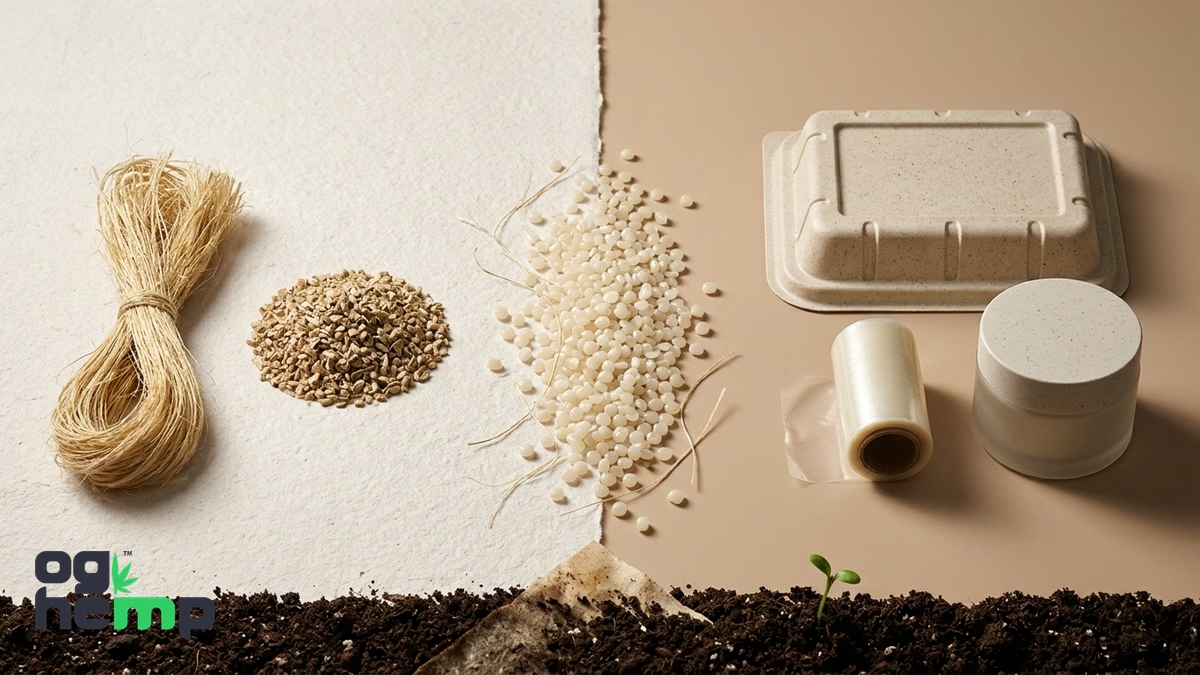
- Four Industrial Formats: Scalable across existing plastic conversion equipment for thermoformed thin sheets (0.2–1.5 mm), puncture-resistant blown films (15–60 µm), natural cling wraps (9–15 µm), and rigid moulded structural containers (1.2–4.0 mm).
Hemp bioplastic packaging is revolutionizing sustainable materials by bridging the critical performance gap between brittle, single-use petroleum polymers and eco-friendly packaging that genuinely returns to the earth. For decades, consumer brands and packaging engineers have struggled with a central dilemma: traditional plastics deliver unmatched moisture resistance, barrier protection, and high-speed machine processability, but linger in ecosystems for centuries. Conversely, first-generation bioplastics often soften under heat, tear prematurely on packaging lines, or demand specialized industrial composting facilities that rarely exist in municipal waste streams. By combining bio-based aliphatic polyesters—specifically Polybutylene Succinate (BioPBS)—with structural hemp bast micro-fibers and cellular hurd particles, modern packaging science has unlocked a regenerative alternative designed to decompose safely where packaging most frequently ends up: in ambient nature and living soil.
Why does most commercial “compostable” packaging fail to degrade in natural environments?
Most commercial compostable packaging fails to degrade in nature because the vast majority of first-generation bioplastics are certified exclusively for industrial composting facilities, which require controlled temperatures exceeding 58°C (136°F), high relative humidity, and active mechanical aeration to trigger polymer hydrolysis. When popular biopolymers such as standard Polylactic Acid (PLA) are accidentally discarded in roadside soil, home garden composters, agricultural fields, or aquatic waterways, ambient temperatures rarely reach the critical glass transition temperature ($T_g$) of 55°C–60°C required to initiate polymer chain cleavage. Consequently, a standard PLA cup, fork, or bag can persist in the wild for decades, mirroring the environmental persistence of conventional polyethylene (PE) and polypropylene (PP).
Furthermore, global waste infrastructure studies consistently reveal that over 85% of packaging waste never reaches an industrial composting facility. When well-intentioned brands adopt industrially compostable packaging without access to closed-loop municipal collection streams, the environmental benefit remains largely theoretical. When consumers discover that their “green” packaging persists indefinitely in backyard soil, brand credibility suffers from accusations of greenwashing. True circularity demands materials that are engineered for “ambient resilience”—packaging that withstands the rigor of global supply chains and product shelf life, but readily breaks down into water, carbon dioxide, and organic biomass when exposed to natural soil microbiomes.
What makes BioPBS and hemp fibers an ideal bio-composite pairing?
BioPBS and natural hemp fibers form an ideal composite pairing because the ductile, flexible aliphatic ester matrix of Polybutylene Succinate compensates for the natural rigidity of plant fibers, while high-tensile hemp bast micro-filaments dramatically reinforce the structural modulus and heat resistance of the polymer. Synthesized through the polycondensation of bio-based succinic acid and 1,4-butanediol, BioPBS is an intrinsically biodegradable polyester that soil microorganisms can enzymatically metabolize at ambient temperatures (20°C–25°C). However, neat (unfilled) BioPBS exhibits relatively low flexural stiffness and can deform under elevated mechanical loads.
When compounded with processed industrial hemp, two distinct anatomical fractions of the plant are utilized to tune physical performance:
- Cottonized Bast Micro-Fibers: Sourced from the outer bark of the hemp stalk, these long cellulose filaments boast an exceptional aspect ratio ($p ge 20$) and an intrinsic elastic modulus exceeding 40 GPa. They function as micro-rebar throughout the polymer melt, absorbing mechanical shock, preventing crack propagation, and providing superior tear resistance.
- Micronized Hemp Hurd Particles: Sourced from the inner woody core of the stalk, hurd flour features a porous, low-density cellular structure ($p approx 3.5$). When micronized to fine distributions ($D_{50} approx 45 mutext{m}$), hurd particles serve as a lightweight functional filler that reduces overall resin consumption, increases flexural rigidity, and accelerates natural moisture ingress during end-of-life disintegration.
The synergy between the two fractions resolves the classic dilemma of natural fiber composites: achieving high tensile strength without making the resulting material excessively brittle. By introducing biodegradable coupling agents (such as maleic anhydride grafted polybutylene succinate, PBS-g-MA), the hydrophilic cellulose surfaces bond tightly with the polymer matrix, ensuring efficient stress transfer under load.
How does hemp-reinforced BioPBS compare across key industrial packaging benchmarks?
Hemp-reinforced BioPBS outperforms both conventional petrochemical plastics and first-generation biopolymers by combining elevated heat deflection temperatures, inherent grease resistance, and verified ambient soil biodegradability in a single material system. The comparison below illustrates the functional tradeoffs across primary packaging material classes:
| Material System | Heat Deflection (HDT) | Ambient Soil Degradation | Moisture / Grease Barrier | Persistent Microplastic Risk |
|---|---|---|---|---|
| Petrochemical Plastics (PP / PE) | 95°C – 120°C | Non-Biodegradable (Centuries) | Excellent Hydrophobic | Severe Hazard |
| Standard Bioplastic (Neat PLA) | 50°C – 55°C (Slumps in hot food) | Requires 58°C Industrial Facility | Moderate Barrier | High if littered in nature |
| Moulded Bagasse / Paper Pulp | Up to 90°C (Uncoated) | Biodegradable in soil | Sogginess / Leaks without PFAS | Zero (if unlined) |
| Engineered Hemp-BioPBS Composite | Target >100°C (Heat-Resistant) | Enzymatic Soil Breakdown (20–25°C) | Inherent Water & Oil Resistance | Zero Synthetic Microplastics |
How does hemp fiber accelerate natural biodegradation through the “microbial wick” effect?
Hemp fibers accelerate natural biodegradation through the “microbial wick” effect by functioning as porous, hydrophilic conduits that draw ground moisture and environmental microbes directly into the core of the hydrophobic polymer matrix. In neat synthetic biopolymers, environmental degradation is primarily a surface-erosion phenomenon: bacteria can only attack the outermost molecular layer, resulting in slow decomposition rates in ambient soil. When natural hemp bast or hurd particles are uniformly dispersed throughout BioPBS, their hydroxyl-rich cellulose structure naturally absorbs ambient soil moisture, causing the fibers to swell microscopically.
This localized swelling creates micro-fissures throughout the composite architecture, dramatically multiplying the internal surface area accessible to soil microbes. Filamentous fungi and common soil bacteria—such as Bacillus, Pseudomonas, and Streptomyces—rapidly colonize these micro-channels. The microorganisms secrete extracellular cutinase and esterase enzymes that cleave the ester bonds of the BioPBS polymer chains, converting high-molecular-weight polyesters into simple monomeric metabolites: succinic acid and 1,4-butanediol. These monomers are readily consumed as natural carbon and energy sources, leaving behind only mineralized water, carbon dioxide, and nutrient-dense soil humus without shedding synthetic microplastic fragments.
What packaging formats can be manufactured with hemp biocomposites?
Four primary packaging formats can be manufactured with hemp biocomposites on standard commercial plastics processing equipment: thermoformed rigid thin sheets, puncture-resistant blown films, high-elasticity cling wraps, and dimensionally stable moulded structural containers. By selecting specific grades of aliphatic polyester resins and calibrating fiber loading, converters can target distinct mechanical envelopes without purchasing proprietary, specialized machinery.
How do thermoformed thin sheets and food service lids perform under heat?
Thermoformed thin sheets solve the hot-beverage deformation problem by providing structural rigidity and elevated heat deflection temperatures that prevent lids and food takeaway trays from warping when exposed to boiling soups, hot curries, or fresh coffee. Traditional PLA lids soften noticeably at 55°C, often leading to accidental container collapse and customer burns. Calendered BioPBS sheets compounded with 20% to 35% hemp fiber achieve target heat resistance exceeding 100°C under load, while maintaining snap-fit rim tolerances on standard high-speed thermoforming vacuum lines.
In addition to takeaway beverage lids, these calendered sheets provide an ideal substrate for electronics packaging trays, blister card backings, and chilled food meal trays. The natural tan flecks of the hemp fibers communicate authentic organic origin directly to consumers, eliminating the need for greenwashed paperboard laminates that require chemical separation during recycling.
How do flexible blown films and courier mailers achieve puncture resistance?
Flexible blown films manufactured with nanoscale and micro-bast hemp fibers deliver high tensile strength, exceptional puncture resistance, and complete soil biodegradability for e-commerce courier bags, retail apparel packaging, and agricultural mulch films. Extruding ultra-thin films below 30 µm requires specialized fiber aspect control—utilizing hemp cellulose nanofibrils (CNF) to prevent melt fracture and bubble puncture. For agricultural mulch films, the material can be tilled directly into the soil at the end of the harvest cycle, eliminating the massive labor cost of collecting degraded plastic mulch and preventing soil microplastic contamination.
The presence of micro-cellulose fibrils distributes mechanical strain across the film surface, delivering dart-drop puncture resistance that rivals low-density polyethylene (LDPE). Furthermore, because the film is naturally moisture-tolerant, courier mailers do not lose tensile integrity during monsoon shipping or high-humidity warehouse storage.
How do bio-based stretch and cling wraps maintain elasticity without synthetic plasticizers?
Bio-based cling wraps utilize calibrated natural tackifiers and micro-fibrils to deliver the elastic recovery, tensile elongation (>180% target pre-stretch), and self-adhesion required for pallet wrapping and fresh produce protection without synthetic plasticizers. Standard polyethylene cling film represents one of the largest single-use unrecyclable plastic waste streams globally. A multi-layer co-extruded bio-composite film balances tactile cling on the primary face with a non-tack outer skin, preventing roll-blocking during warm-weather storage while breaking down safely if lost in open terrestrial environments.
By engineering an asymmetric 3-layer film architecture (tackified inner skin, reinforced core, and slip-enhanced outer skin), converters can produce commercial stretch wraps that run smoothly on high-speed automated pallet wrapping turntables as well as manual handheld dispenser rolls for retail kitchens and logistics fulfillment hubs.
How do rigid moulded structural composites replace heavy-wall petrochemical plastics?
Rigid moulded composites replace heavy-wall petrochemical plastics by offering an earthy, satin-matte tactile aesthetic, high dimensional stability, and low mold shrinkage for luxury cosmetic jars, screw caps, closure lids, and electronic protective housings. Combining micronized hemp hurd with cottonized bast fibers delivers an engineered flexural modulus targeting upwards of 3,000 MPa, allowing brands to eliminate polypropylene (PP) and ABS housings while visually communicating authentic sustainable material integrity through organic fiber specks.
The high thermal conductivity of natural fibers accelerates in-mold cooling times, allowing injection molding cycle times (13 to 22 seconds) that match conventional petroleum plastics. This enables packaging converters to maintain factory throughput and unit economics without modifying existing steel injection tool molds.
How do international standards measure true soil biodegradability?
International standards measure true soil biodegradability by establishing rigorous testing protocols that evaluate aerobic mineralization into carbon dioxide in real terrestrial soil environments at natural ambient temperatures (20°C to 25°C), completely separate from high-temperature industrial composting regimes. Procurement teams and brand managers evaluating sustainable packaging claims should reference verified analytical frameworks:
- ISO 17556 / ASTM D5988 (Aerobic Soil Biodegradation): The primary benchmarks for determining the degree and rate of aerobic biodegradation of plastic materials in contact with natural soil. Testing tracks the respirometric evolution of $CO_2$ over a multi-month period, requiring that at least 90% of the organic carbon mineralizes within a maximum of 24 months at ambient temperatures.
- TÜV OK Compost SOIL: One of the world’s most rigorous third-party certifications for open-environment packaging, verifying that a material completely biodegrades in natural outdoor soil without requiring any human waste-management intervention.
- OECD 208 (Terrestrial Plant Growth Ecotoxicity): Crucial for confirming soil safety, this test verifies that the degraded composite biomass and degradation byproducts have zero negative impact on seed germination, seedling emergence, and early vegetative growth in sensitive plant species like summer barley and cress.
- EU Packaging and Packaging Waste Regulation (PPWR) & SUPD: Aligns with the stringent requirements of the EU Packaging and Packaging Waste Regulation (PPWR) and the Single-Use Plastics Directive (SUPD), which mandate that plastic packaging materials either achieve high mechanical recyclability or full biological disintegration without chemical additives or microplastic shedding.
- IS 17088 / CPCB Regulatory Framework (India): Governed by the Central Pollution Control Board (CPCB) under the Plastic Waste Management (PWM) Rules, this standard certifies compostable plastics. Form A registration enables manufacturers to comply with strict Extended Producer Responsibility (EPR) guidelines while transitioning away from banned single-use polymers.
Will hemp biocomposite packaging degrade prematurely on a warehouse shelf?
Hemp biocomposite packaging will not degrade on a warehouse shelf because the biological breakdown mechanism requires active soil microorganisms, adequate moisture content, and environmental microbial enzymes to trigger hydrolysis. In indoor storage conditions, dry retail environments, or standard warehouse distribution channels, relative humidity levels remain below the biological threshold required to initiate bacterial colonisation. The material maintains its tensile integrity, barrier properties, and dimensional stability throughout its intended commercial shelf life, initiating decomposition only after prolonged contact with damp soil biomes or active composting substrates.
Yes, hemp bioplastic composites can be processed on standard plastics machinery, including single and twin-screw extruders, blown film lines, cast sheet calenders, and conventional injection moulding presses. Processing guidelines recommend maintaining barrel temperatures below 165°C to preserve the integrity of natural hemp cellulose and prevent fiber pyrolysis.
No, hemp-reinforced biocomposite packaging is 100% PFAS-free and relies on the inherent hydrophobic polymer matrix of aliphatic polyesters and dense cellulose packing to provide natural grease, fat, and oil resistance without fluorochemical coatings or hazardous plasticizers.
Hemp bioplastic composites outperform paper and bagasse packaging by delivering superior barrier resistance against hot liquids and oils without soaking or softening, while eliminating the substantial tare weight and freight cost penalties associated with heavy moulded pulp containers.
The difference between home compostable and soil biodegradable packaging is that home composting requires the elevated biological warmth of a managed compost bin (typically 25°C–30°C), whereas soil biodegradability certifies that a material will naturally decompose when buried directly in ambient earth or agricultural soil without any human composting management.
Ready to partner with OG Hemp on next-generation bio-composites?
OG Hemp collaborates directly with enterprise packaging converters and consumer brands to engineer custom bio-composite formulations that replace single-use plastics without requiring tooling re-investment. Connect with our material science team to request Technical Data Sheets (TDS), compounding specifications, and custom conversion samples for your production line.