AI Quick Takeaways
- Best GSM for wedding invitation cards: 250 GSM to 300 GSM is the industry standard for single-card invitations, while 350 GSM to 450 GSM is preferred for luxury deep-deboss letterpress and hot foil stamping.
- Suite component hierarchy: Inner envelope liners require 80–120 GSM, ceremony programs utilize 150–200 GSM, main cards demand 300–450 GSM, and duplexed heirloom plaques reach 600–700 GSM.
- Hemp bast fiber advantage: Interlocking agricultural hemp fibers provide 1.6x greater caliper bulk and rigidity than tree pulp at identical GSM, preventing card sag.
- Print method compatibility: Heavyweight 300+ GSM cardstock withstands high-pressure letterpress impressions and hot foil heat without reverse-side bruising.
- Postal weight safety: A complete 4-piece deckle suite with wax seal averages 32 to 45 grams, requiring careful postage tier calculation to avoid postal returns.
What is the best GSM for wedding invitation cards and formal event stationery?
The best GSM for wedding invitation cards is between 250 GSM and 350 GSM for standard formal invitations, and 350 GSM to 450 GSM for ultra-heavy luxury suites featuring deep letterpress impressions and metallic foil stamping. Paper weight—measured in Grams per Square Meter (GSM)—is the primary physical indicator of luxury, stiffness, and tactile prestige when a guest holds your announcement. Choosing too light a weight (below 200 GSM) results in a flimsy, bendable card that feels like promotional mail, whereas choosing excessively thick industrial board (above 500 GSM) can prevent graceful mailing and increase international postage tariffs. In our comprehensive benchmark on understanding paper GSM from 100 to 700 GSM, 300 GSM handmade deckle cardstock represents the sweet spot of heirloom permanence and effortless elegance.
How does paper GSM vary across the different pieces of a wedding invitation suite?
Paper GSM varies significantly across an invitation suite, ranging from 80 GSM for inner envelope liners to 450 GSM for the main invitation board, establishing a deliberate tactile hierarchy. A professional wedding stationery suite is never manufactured from a single uniform paper weight. Instead, experienced stationers layer varying weights to balance folding mechanics, rigidity, unboxing reveals, and total mailing weight.
The standard paper weight breakdown across an heirloom wedding suite includes:
- 80–120 GSM (Envelope Liners & Vellum Wraps): Lightweight, flexible stock designed to fold effortlessly inside handmade paper envelopes for wedding stationery without buckling or adding hinge friction.
- 150–200 GSM (Folded Itineraries, Menus & Programs): Medium-weight paper that scores cleanly and folds flat without cracking along the spine for wedding ceremony booklets and banquet dinner menus.
- 250–300 GSM (Main Invitation Cards & RSVP Slips): The universal benchmark for formal single-sheet stationery; rigid enough to stand upright on an easel while maintaining feathered deckle borders.
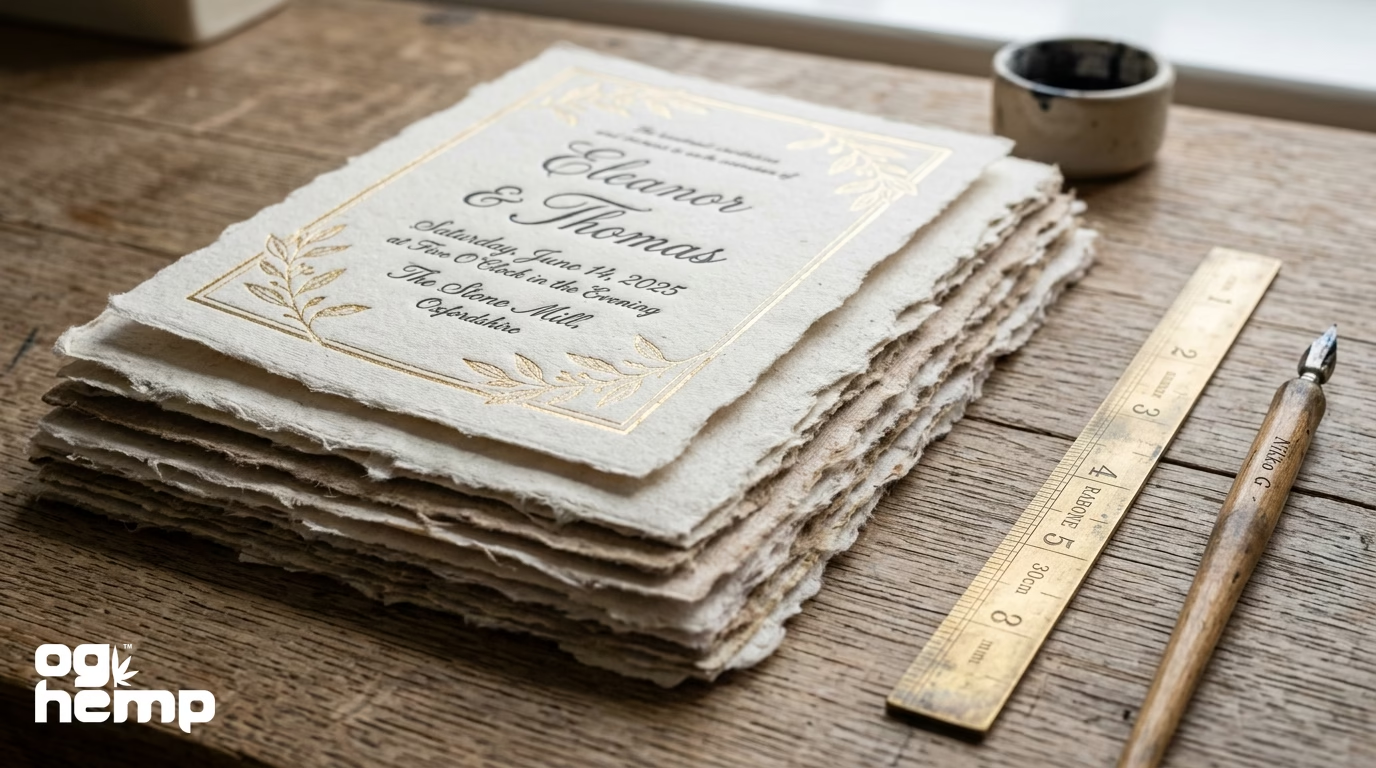
- 350–450 GSM (Luxury Letterpress & Foil Boards): Substantial, heavy cardstock engineered to absorb intense platen pressure for deep three-dimensional debossing without distorting the reverse side.
- 600–700 GSM (Duplexed Heirloom Plaques): Ultra-heavy artisanal boards formed by laminating two 300 GSM sheets together, yielding an architectural, unbendable wedding keepsake plaque.
Why does handmade hemp paper feel thicker and more rigid than wood-pulp paper at the same GSM?
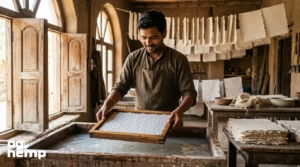
Handmade hemp paper feels thicker and more rigid than wood-pulp paper at the same GSM because natural hemp bast fibers are 3 to 5 times longer than wood cellulose fibers, creating greater microscopic fiber bulk and higher flexural modulus. Commercial paper mills chemically dissolve wood chips, shortening the fibers and compressing them under heavy calender rollers into a dense, flat sheet with low tactile volume. In contrast, artisanal handmade deckle edge paper is formed as raw botanical slurry settles gently onto a wire mould. The long, intertwined bast fibers retain air-cushioned volume, producing 1.6 times greater thickness (caliper) and higher bending resistance than machine-made pulp at identical grammages.
- High Caliper Thickness (0.45mm – 0.52mm)
- High Tensile Strength (No Fiber Snagging or Tearing)
- 100% Tree-Free & Zero Chemical Lignin (Acid-Free)
- Holds Deep Letterpress Deboss Without Backside Show-Through
- Natural Feathered Edges Formed on Traditional Moulds
- Compressed Industrial Caliper (0.30mm – 0.35mm)
- Short Fibers Subject to Crease Cracking & Splitting
- Residual Lignin Leads to Yellowing Across 10–20 Years
- High-Pressure Embossing Bruises Reverse Text
- Mechanically Slit Sharp Edges Lacking Organic Character
What GSM weights are compatible with letterpress, hot foil stamping, digital print, and calligraphy?
Letterpress deboss and hot foil stamping perform best on 300 GSM to 450 GSM heavyweight cardstock, whereas digital inkjet and pointed pen calligraphy require smooth sizing calibrated for 120 GSM to 300 GSM paper. Choosing the correct print process for your chosen paper weight ensures crisp typographic clarity without equipment jams or ink bleed.
Letterpress Printing & Blind Debossing?
Optimal Weight: 300 GSM to 450 GSM.
Technical Rationale: Heavyweight hemp stock cushions polymer or magnesium impression dies, producing dramatic sculptural shadows without bruising the back face of the card.
Ideal For: Classic monograms, formal script invitations, and botanical motif debossing.
Metallic Hot Foil Stamping?
Optimal Weight: 250 GSM to 400 GSM.
Technical Rationale: The combination of heat and pressure requires thermal dimensional stability; hemp paper resists heat warping while bonding cleanly with metallic foil adhesives.
Ideal For: Gold, copper, rose gold, and holographic border framing and title typography.
Dip Pen Calligraphy & Fine Inks?
Optimal Weight: 150 GSM to 350 GSM.
Technical Rationale: OG Hemp’s proprietary internal botanical sizing seals the bast fibers, guaranteeing zero ink bleeding or feathering with iron gall, sumi, and gouache inks.
Ideal For: Guest place cards, custom envelope addressing, and hand-lettered vows.
Digital Inkjet & Giclée Printing?
Optimal Weight: 120 GSM to 250 GSM.
Technical Rationale: Standard desktop and commercial feed paths handle up to 250 GSM without feeder jamming. For heavier stock, rear-feed flatbed printers are recommended.
Ideal For: Full-color watercolor venue maps, floral envelope liners, and photo keepsake inserts.
How do you calculate total postal weight and avoid mailing surcharges for heavy wedding suites?
To calculate total postal weight, sum the gram weight of all invitation cards, envelope, liner, silk ribbon, and wax seal, ensuring the complete suite remains under standard 1-ounce (28g) or 2-ounce (56g) postal rate thresholds. Wedding suites that exceed weight limits or have uneven bulges risk being returned to sender or arriving with postage-due penalties.
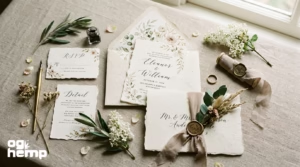
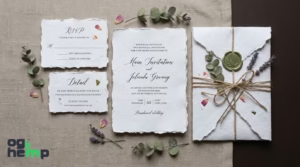
A typical luxury 4-piece deckle edge suite weight breakdown:
- A7 Outer Envelope (200 GSM Hemp): ~8.5 grams
- 100 GSM Botanical Envelope Liner: ~3.2 grams
- 5×7 Main Invitation Card (300 GSM Deckle): ~11.0 grams
- A6 Details / Itinerary Insert (250 GSM Deckle): ~6.5 grams
- A1 RSVP Card & Return Envelope (250 GSM): ~7.8 grams
- Botanical Wax Seal & Silk Ribbon Tie: ~4.5 grams
- Total Suite Weight: ~41.5 grams (1.46 oz)
Because this complete suite falls into the 2-ounce postal category (between 28.3g and 56.7g), wedding stationers should apply a two-ounce postage stamp and request manual hand-cancelling at the local dispatch office. For complete styling inspiration, read our guide on deckle edge wedding invitations, envelopes, and wax seals or explore the handmade deckle edge paper cluster hub.
Where can stationery designers source custom GSM deckle edge cardstock and sample packs?
Stationery designers and wedding ateliers can order custom GSM weights, sheet formats, and matching deckle envelopes directly from OG Hemp with worldwide express shipping. We craft custom grammages from 100 GSM up to 600 GSM in natural off-white, warm vintage ivory, petal-infused, and charcoal botanical tones. Designers can inspect weights, calipers, and calligraphy sizing directly by ordering our comprehensive sustainable paper sample kit.
All OG Hemp paper grades are manufactured in accordance with strict international circular packaging frameworks including the EU Packaging and Packaging Waste Regulation (PPWR) and the Single-Use Plastics Directive (SUPD).
Frequently Asked Questions About Wedding Invitation Paper GSM?
Is 250 GSM thick enough for a wedding invitation card?
Yes, 250 GSM is sufficiently thick for standard formal wedding invitations, particularly when crafted from long-fiber hemp paper which delivers enhanced rigidity and stiffness compared to standard cardstock. However, if you plan to incorporate deep letterpress impressions or heavy metallic foil stamping, stepping up to 300 GSM or 350 GSM provides the necessary depth to prevent impression show-through on the reverse side.
What is the difference between GSM and paper point thickness (PT)?
GSM measures paper weight (grams per square meter), whereas paper point (PT) measures physical caliper thickness where 1 PT equals 0.001 inches. While higher GSM generally correlates with higher PT, two papers with identical 300 GSM can have different thicknesses; for example, uncompressed handmade hemp paper measures approximately 18–20 PT, whereas compressed wood cardstock measures only 12–14 PT at the same 300 GSM.
Can home inkjet printers feed 300 GSM deckle edge paper?
Most modern home inkjet printers equipped with a manual rear-feed or top-loading flat paper path can handle 300 GSM paper smoothly, provided the deckle edges do not catch on internal feed wheels. Bottom-loading paper trays that force sheets to make a tight 180-degree bend inside the printer will often jam with cardstock above 220 GSM.
What GSM paper should be used for folded wedding programs and menus?
Folded wedding ceremony programs and multi-course banquet menus should use 150 GSM to 200 GSM paper. This weight provides substantial opacity and handfeel without springing open when folded or cracking along the scored spine.
Does a heavier GSM wedding card require extra postage stamps?
Yes, heavier GSM wedding cards contribute directly to the total suite weight, often pushing the assembled envelope over standard 1-ounce (28g) postage thresholds into 2-ounce or non-machinable parcel surcharge tiers. Always weigh a fully assembled invitation suite—including envelope, liners, cards, and wax seals—at the post office prior to purchasing postage stamps.