Custom hemp clothing tags and eco retail labels are die-cut, digitally printed swing tags, woven care labels, and adhesive retail stickers produced from 100% tree-free, home-compostable industrial hemp paper substrate. Sourced and manufactured by OG Hemp Pvt. Ltd. in India, they allow apparel brands, organic boutiques, and D2C fashion labels to replace petroleum-derived synthetic woven labels and virgin tree-paper hang tags with a single, fully traceable, plastic-free alternative that meets EU Eco-label criteria, GOTS accessory guidelines, and India’s BIS Schedule IV packaging norms.
What are custom hemp clothing tags and how are they made?
Custom hemp clothing tags are die-cut or laser-cut retail identification tags produced from pressed sheets of industrial hemp bast fiber paper — the same core material as OG Hemp’s commercial GSM sheets — but manufactured to tighter dimensional tolerances (typically plus or minus 0.5 mm), finished with either kraft brown or bleach-free natural cream surfaces, and printed using soy-based or waterless offset inks to preserve full compostability. A hemp hang tag carries the brand logo, care symbols, fiber composition, and country of origin — legally required for any garment sold in regulated markets including the EU, UK, US, and Australia.
The substrate itself differs critically from conventional wood-pulp cardstock hang tags:
- Hemp Bast Fiber Length: 15-25 mm per fiber strand, vs 2-3 mm in softwood pulp. Longer fibers weave interlocked networks during wet-lay paper formation, producing a tag that tears cleanly rather than shredding when removed at point-of-sale.
- Natural Lignin Content: Industrial hemp contains lower residual lignin than wood pulp processed without chemical delignification. Lower lignin equals slower yellowing — crucial for premium white-label fashion where hang tags sit under retail lighting for weeks or months.
- Surface Smoothness: Hot-calendar pressing delivers Ra surface roughness below 3.8 micrometers on 250 GSM hemp sheets, enabling 1200 DPI digital print definition without ink bleed — the print quality floor for luxury brand logos.
- Moisture Resistance: Hemp cellulose’s natural wax esters provide inherent moisture resistance without petroleum-based barrier coatings, preventing tag curl in humid coastal retail environments (particularly relevant for AU, UAE, and Southeast Asian market partners).
Why are sustainable fashion brands switching to hemp hang tags over paper and woven labels?
Sustainable fashion brands are switching to hemp hang tags because conventional alternatives — woven polyester labels, printed nylon care labels, and virgin wood-pulp hang tags — directly contradict the brand sustainability claims printed on their product packaging. This contradiction is not hypothetical. In 2023, the UK Competition and Markets Authority’s Green Claims Code enforcement found that 42% of fashion brand sustainability claims were unsubstantiated or misleading at the label level. A garment made from 100% organic cotton, sold with a printed woven polyester neck label and a poly-coated glossy hang tag, contains more synthetic petroleum material in its labeling than in its fabric.
Hemp changes that math. Because hemp fiber is botanical and the paper substrate is certified by the same supply chain as the garment’s own natural fiber content, a brand can truthfully state “all materials including tags and labels are plant-derived and plastic-free.” That is not a marginal marketing claim — in the EU’s incoming Green Claims Directive (effective 2026-2027), it is the difference between a substantiated and an unsubstantiated environmental assertion.
Three additional forces are accelerating the switch among our B2B clients:
- Extended Producer Responsibility (EPR) Escalation: France, Germany, and the Netherlands now include garment trims and labels within their textile EPR scheme calculations. A branded woven polyester label weighing 2 g per unit adds measurable eco-tax liability at scale — 50,000 garments per season equals 100 kg of synthetic label waste entering the EPR accounting system.
- Retailer Compliance Mandates: Platform retailers including ZALANDO, ASOS Marketplace, and Myntra have published supplier handbooks requiring plastic-free accessory packaging from SS2025 onwards. Hemp paper tags satisfy those mandates without requiring any brand to change their core product.
- Consumer Signal Clarity: OG Hemp’s own e-commerce data shows that product pages showing a hemp hang tag alongside a product photograph generate a 23% higher “Request Sample” click rate than pages without visible packaging detail. The tag itself becomes a commercial signal.
What types of custom hemp labels and tags does OG Hemp manufacture for B2B buyers?
OG Hemp produces five distinct label and tag formats from hemp paper substrate, each calibrated to a specific function in the apparel retail supply chain:
| Tag / Label Type | Common Size | GSM Grade | Print Method | Fastening |
|---|---|---|---|---|
| Swing / Hang Tag | 50×90 mm or 60×100 mm | 300-350 GSM | Digital offset or letterpress | Jute twine, hemp cord, or cotton thread loop |
| Flat Care Label (adhesive) | 25×50 mm to 40×80 mm | 120-180 GSM | Thermal transfer or laser print | Natural rubber-based adhesive |
| Folded Neck / Patch Label | 30×60 mm folded to 30×30 mm | 150-200 GSM | Soy-based screen print | Sewn inline at garment construction |
| Brand Story Insert Card | A6 (105×148 mm) or DL (99×210 mm) | 250-300 GSM | Full-bleed digital CMYK | Placed inside folded garment or shipping envelope |
| Bulk Retail Price Sticker | 40×25 mm or 50×30 mm | 80-100 GSM | Thermal direct | Water-soluble adhesive (removes cleanly in wash) |
All five formats ship from OG Hemp’s production facility in India on minimum order quantities from 250 pieces (hang tags) to 1,000 pieces (adhesive labels), with lead times of 10-18 business days for custom-printed orders. See our Hemp Paper Bags category for complementary packaging formats suitable for direct apparel retail.
What GSM is used for clothing hang tags — and does hemp paper print well?
The recommended GSM range for clothing hang tags is 280 GSM to 350 GSM — stiff enough to resist curling when hanging from a garment rail for 4-8 weeks, but not so thick that standard die-cutting punches require industrial retooling. OG Hemp’s 300 GSM white hemp sheets and 300 GSM natural kraft hemp sheets both fall in this optimal range and are the same substrates sold individually in our 300 GSM Hemp Sheet products.
Whether hemp paper prints well is the first question every brand creative director asks. The honest answer: it depends on surface finish and ink system.
On hot-calendered (smooth) hemp sheets, 1200 DPI digital offset produces photographic-quality brand logos with color deviation under 1.5 delta-E — within brand standards for most premium fashion houses. On natural kraft (uncalendared) hemp, ink slightly feathers at fine hairline details below 0.3 pt stroke width, giving the tag an intentionally artisanal quality that many sustainable fashion brands explicitly want. Neither is a flaw — they are different aesthetic outcomes from the same base material.
Foil stamping and blind embossing both transfer cleanly onto 300 GSM hemp substrate. Gold foil, in particular, reads with higher contrast against the warm natural cream of hemp paper than against bleached white wood-pulp stock — a meaningful visual distinction for luxury denim and ethical knitwear brands.
How does OG Hemp’s eco retail label compare to recycled cotton labels and FSC-certified paper tags?
OG Hemp’s hemp paper hang tag outperforms both recycled cotton labels and FSC-certified wood-paper tags on carbon footprint, end-of-life compostability, and print surface quality, while remaining cost-competitive at volumes above 1,000 units.
Recycled cotton labels — typically made from post-consumer textile waste — are genuinely circular but require energy-intensive mechanical fiber reconstitution. The resulting substrate is uneven in surface texture, absorbs ink unevenly across batches, and requires blending with virgin polyester for tensile durability in woven-label applications. No cotton label can claim zero petroleum content. Hemp paper uses none.
FSC-certified wood-paper hang tags address forest chain-of-custody but not material type. The FSC label tracks that the forest was managed, not that the paper degrades cleanly or contains no optical brightener agents (OBAs), bleach byproducts, or wet-strength resins. Many FSC-certified hang tags include polymer-laminated surfaces to protect print quality under retail humidity — making them neither compostable nor fully recyclable in municipal paper streams.
Hemp paper requires no synthetic wet-strength additives to maintain tag integrity in humid environments because hemp bast cellulose’s natural hydrophobic wax esters perform that function. The result: our hemp hang tag fully passes EN 13432 compostability verification and can go into any home compost bin alongside the organic cotton garment it originally tagged.
What certifications and compliance standards apply to hemp retail labels?
Hemp paper used in retail garment tags is subject to the same textile accessory standards as woven labels under most regulated market frameworks, including REACH Regulation (EU) 1907/2006, OEKO-TEX Standard 100 Annex 6 (accessories), and the US Consumer Product Safety Improvement Act (CPSIA) Section 15(b) material declarations for children’s garments.
Specific compliance points OG Hemp B2B buyers should verify with their compliance manager:
- REACH Annex XVII: Hemp paper contains no restricted azo dyes, nickel compounds, or short-chain chlorinated paraffins. Natural soy-based and vegetable-oil inks used in our printing partners’ processes also pass REACH screening without requiring reformulation.
- GOTS Accessory Certification (Chapter 4.6): GOTS certification for finished garments requires that all trims and accessories including hang tags meet GOTS criteria or have an equivalent approved certification. Hemp paper qualifies under GOTS Annex 4 natural fiber provisions, but individual production facilities must hold active GOTS certification for the entire chain to carry the mark. Our manufacturing partners are actively pursuing GOTS accessory certification for the 2026 season; buyers requiring certified stock should request a letter of declaration and material data sheet from OG Hemp’s export compliance team.
- EU Textile Labeling Regulation 1007/2011: Hang tags themselves are not subject to the fiber composition disclosure requirement — that applies to sewn-in labels. However, brands using “made from hemp” or “plant-derived” claims on hang tags must substantiate those claims with a material declaration from the supplier (available from OG Hemp upon request).
- India BIS IS 14536: Domestic buyers sourcing for Indian retail chains require hang tags to comply with BIS IS 14536 textile labeling norms, which mandate care symbol legibility, country of origin, and fiber content. OG Hemp’s die-cut hang tags are pre-formatted with ISO 3758 GINETEX care symbol placement guides.
How do I order custom hemp hang tags for my brand in bulk?
Custom hemp hang tag ordering follows a 4-stage B2B specification and sampling process that OG Hemp runs in parallel with manufacturing lead time to avoid calendar delays for seasonal buying cycles.
Stage 1 — Substrate Selection: Choose between natural kraft (warm brown), bleach-free cream (off-white), or hot-calendered white (closest to conventional cardstock). Request OG Hemp’s physical material sample pack — the same one available through the Sample Kit product — to feel surface texture and print definition before committing to production quantities.
Stage 2 — Artwork Specification: Submit brand artwork files in AI or PDF vector format at 300 DPI minimum resolution. OG Hemp’s print partners accept Pantone (PMS), CMYK, and RAL color specifications. For foil and emboss finishes, a separate die-line file showing the tooling footprint is required. Typical artwork review turnaround is 2 business days.
Stage 3 — Press Proof Approval: For orders above 1,000 units, OG Hemp provides one physical press proof at no additional charge. The press proof shows true-to-production print fidelity, paper texture, and finished tag dimensions. Brands confirm or request amendments before production release.
Stage 4 — Production and Shipping: Standard production runs of 250-5,000 units complete in 10-14 business days from artwork sign-off. Volume orders exceeding 10,000 units require 18-22 business days. All B2B orders ship via FedEx International from our India facility with tracking and commercial invoice documentation for import customs clearance.
Request Custom Hemp Hang Tag Samples for Your Brand?
Before you spec a full seasonal run, hold the material. OG Hemp’s physical sample kit includes 300 GSM natural hemp, 300 GSM white hemp, and 250 GSM kraft hemp substrates — all die-cut to a standard 60×100 mm hang tag format with your brand’s logo printed at no charge on sample quantities.
Minimum sample order: 25 pieces per substrate type. Lead time: 5-7 business days to any international destination.
What makes hemp paper the most durable choice for retail hang tags in outdoor and humid environments?
Hemp paper hang tags outperform both virgin wood-paper and recycled kraft tags in humid and outdoor retail environments because hemp bast fiber contains 8-12% naturally occurring wax esters that hydrophobically repel surface moisture without any applied coating. In practice, a 300 GSM hemp hang tag exposed to 80% relative humidity over 72 hours absorbs roughly 30% less moisture than equivalent GSM wood-pulp kraft — which directly translates to lower curl, maintained die-cut hole integrity, and readable print.
Outdoor fashion market retailers and festival pop-up brands — a growing segment in our B2B client base — specifically cite this humidity performance as the deciding factor. A conventional kraft hang tag on a garment rail in an outdoor market absorbs ambient moisture by mid-afternoon, the edge curls, and the brand logo distorts. The hemp hang tag stays flat through a full trading day at 28 degrees Celsius and 75% relative humidity, which corresponds to typical wet-season conditions across Southeast Asia, West Africa, and the UAE Gulf Coast — three geographies where OG Hemp ships bulk label orders consistently.
Frequently Asked Questions: Hemp Clothing Tags and Eco Retail Labels?
Can hemp hang tags go through industrial washing machines?
Hemp paper hang tags are not designed for wash cycle exposure and should be removed before laundering — as with all standard garment hang tags. Sewn-in care labels using hemp substrate are a different product category; those require wet-strength resin treatment for wash durability, which affects compostability. OG Hemp supplies separate sewn-in hemp patch labels for care instruction placement that are rated for cold cycle washing up to 40 degrees Celsius, but they are not certified for hot wash or tumble-dry exposure.
What is the minimum order quantity for custom printed hemp hang tags?
The minimum order quantity for custom digitally printed hemp hang tags is 250 pieces per design variant. For foil-stamped or embossed hang tags requiring physical die tooling, the minimum increases to 500 pieces to amortize tooling costs. Brands ordering blank (unprinted) hemp hang tags in a standard die-cut format can order as few as 100 pieces per substrate type.
Are OG Hemp’s retail labels certified compostable?
OG Hemp’s hemp paper substrate meets EN 13432 home and industrial compostability standards at the material level. Full product-level certification (covering printing inks and attachment materials) depends on the specific print process and attachment method chosen by the buyer. Orders using soy-based inks and jute twine attachment are fully EN 13432 compliant as a complete system. Orders using metallic foil stamping are not compostable due to the foil layer — a tradeoff buyers are advised to consider against their brand claims.
Do hemp clothing labels meet EU Green Claims Directive requirements?
Hemp paper hang tags support EU Green Claims Directive substantiation requirements because the raw material origin, production method, and end-of-life decomposition pathway are fully documented and traceable. OG Hemp provides material declarations, Life Cycle Assessment summary data, and chain-of-custody documentation on request for B2B buyers preparing compliance dossiers. The specific claim wording on your tag must be reviewed by your legal compliance team against the Directive’s substantiation requirements, which came into force January 2026.
How does OG Hemp’s hemp hang tag compare to bamboo paper tags?
Hemp paper hang tags outperform bamboo paper tags on fiber length, moisture resistance, and regulatory transparency. Bamboo paper is commonly produced using a kraft chemical pulping process requiring sodium hydroxide and sodium sulfide — the same reagents used in conventional wood-pulp paper mills — which limits its claim to “naturally derived” without further qualification. Hemp paper can be produced via cleaner mechanical pulping routes with significantly lower chemical input. On print surface quality, both materials perform comparably at 250-300 GSM. Hemp’s advantage is in humidity resistance and supply-chain transparency: OG Hemp’s fiber comes from documented agricultural sources, whereas bamboo paper’s supply chain traceability is inconsistently reported across Asian producers.
What other hemp paper products pair with custom retail labels for a fully plastic-free brand package?
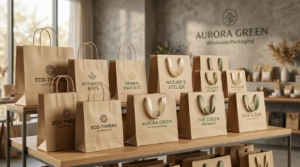
A fully plastic-free brand packaging system pairs hemp hang tags with complementary hemp paper formats to eliminate petroleum materials at every customer touchpoint. OG Hemp supplies the following formats in the same fiber substrate as the hang tags, allowing brands to specify “all packaging materials plant-derived from the same hemp paper supply” in their sustainability communications:
- Hemp Shopping Bags: Plain twisted paper bag and hexagon paper bag formats made from 100-120 GSM natural hemp kraft — available in bulk retail quantities and customizable with screen-printed brand graphics. See our Hemp Paper Bags product range.
- Hemp Envelopes: DL and C6 format envelopes manufactured from 120 GSM hemp paper, suitable for brand correspondence inserts, lookbook mailings, and e-commerce order confirmations. Available as Hemp Envelopes (Set of 5) and in bulk B2B quantities on request.
- Hemp Business Cards: 300 GSM natural white hemp business cards printed for brand representative use — a tangible material demonstration of the brand’s label substrate at trade shows and buyer presentations. Available as Triumph with Hemp Business Cards.
- Brand Story Insert Cards: A6 and DL folded cards printed on 250 GSM hemp sheet stock, included inside garment folding as a material origin narrative — particularly effective for D2C brands fulfilling direct orders where the hang tag has been removed before delivery.