As international sustainability mandates tighten under 2026 Extended Producer Responsibility (EPR) laws and European Union plastic reduction directives, brand managers and packaging engineers are replacing traditional fossil polymers. However, relying on a single bioplastic often leads to performance trade-offs: rigid materials like Polylactic Acid (PLA) lack ocean degradability, while unreinforced microbial resins can suffer from secondary crystallization brittleness during injection molding.
To build a truly resilient, plastic-free packaging portfolio, modern material science leverages two distinct yet complementary biopolymers: Polyhydroxyalkanoates (PHA) and Polybutylene Succinate (Bio-PBS). In this technical 2026 guide, we compare how PHA and Bio-PBS differ in synthesis, mechanical flexibility, and end-of-life breakdown, and demonstrate how reinforcing both polymers with sustainable hemp hurd and bast fibers creates high-performance, structurally superior biocomposite packaging.
What are PHA and Bio-PBS bioplastics and why are both vital in 2026?
PHA and Bio-PBS are two leading sustainable biopolymers that replace petroleum plastics by providing certified compostability, carbon-neutral feedstock origins, and zero microplastic accumulation under global packaging directives.
While both materials fulfill the overarching objective of sustainable, circular packaging, they possess fundamental chemical differences. Polyhydroxyalkanoates (PHA) excel in ambient marine degradability and oxygen barrier performance, making them ideal for ocean-safe packaging and moisture-sensitive foods. Conversely, Polybutylene Succinate (Bio-PBS) behaves mechanically like Low-Density Polyethylene (LDPE) and Polypropylene (PP), delivering high ductility, melt strength, and thermal stability required for flexible pouches, squeeze tubes, and high-impact containers.
How do PHA and Bio-PBS differ in synthesis, performance, and degradation?
PHA and Bio-PBS differ in their manufacturing origin, mechanical flexibility, and ambient degradation pathways, offering complementary physical profiles for packaging engineers.
Synthesis & Origin: Fermentation vs. Polycondensation?
PHA is synthesized biologically inside bacterial cells via fermentation of plant sugars, vegetable oils, or agricultural waste, accumulating as natural intracellular energy granules. Bio-PBS is synthesized chemically via polycondensation of succinic acid and 1,4-butanediol derived from renewable bio-feedstocks like sugarcane or corn starch.
Mechanical Properties: Rigidity & Barrier vs. Ductility & Flexibility?
Pure PHA homopolymers (like PHB) are stiff, highly crystalline, and exhibit exceptional oxygen barrier properties, but can suffer from narrow processing windows and brittleness. In contrast, Bio-PBS is inherently flexible, tough, and ductile, exhibiting high elongation at break (>300%) and a melting point of ~115°C, allowing it to withstand high impact and thermal stress without cracking.
Biodegradation Profile: Ambient Ocean vs. Soil & Home Compost?
PHA is unique in achieving rapid ambient biodegradation across marine water, freshwater, soil, and home compost environments without requiring elevated heat. Bio-PBS biodegrades rapidly in soil and industrial/home compost systems under ISO 14855 standards, though its marine breakdown occurs at a slower rate than specialized PHA copolymers (PHBH).
What are the core variants of PHA and Bio-PBS used in eco-packaging?
The primary commercial biopolymer grades include 5 distinct PHA variants (PHB, PHBV, PHBH, P4HB, P3HB4HB) alongside flexible Bio-PBS grades, allowing manufacturers to select exact mechanical profiles.
- PHB (Polyhydroxybutyrate): Stiff, highly crystalline homopolymer with gas barriers matching PET.
- PHBV (PHB-co-valerate): Copolymer with improved melt flexibility for thermoforming and barrier films.
- PHBH (PHB-co-hydroxyhexanoate): Ductile copolymer certified for marine biodegradability.
- P4HB & P3HB4HB: Elastomeric copolymers delivering high tensile toughness for specialized closures.
- Bio-PBS (Polybutylene Succinate): High-ductility polyester used for film blowing, paperboard extrusion coating, and injection molding.
How do hemp fiber biocomposites improve the mechanical properties of PHA and Bio-PBS?
Compounding micro-milled hemp hurd or bast fibers into PHA and Bio-PBS resins doubles structural flexural modulus and elevates heat deflection temperatures while increasing renewable plant-based carbon content.
Uncompounded PHA resins can experience secondary crystallization brittleness over time, while neat Bio-PBS can lack the flexural stiffness required for rigid containers. By compounding 30% to 50% by weight of micro-milled hemp hurd (the woody inner core) or high-tensile hemp bast fiber, compounding facilities create a reinforced natural fiber matrix. In Hemp-PBS composites, hemp fibers add necessary structural rigidity and dimensional stability. In Hemp-PHA composites, the lignocellulosic fiber network acts as a physical reinforcing scaffold, mitigating brittleness and expanding the thermal processing window.
Comprehensive Material Performance Matrix: PHA vs. Bio-PBS vs. Hemp Biocomposites?
| Material Variant | Synthesis Method | Tensile Modulus (GPa) | Elongation at Break (%) | Heat Deflection Temp (°C) | Marine Biodegradation |
|---|---|---|---|---|---|
| Pure PHB (PHA) | Microbial Fermentation | 3.5 – 4.0 | < 5% | 85°C | 90-120 Days |
| Pure Bio-PBS | Polycondensation | 0.5 – 0.8 | > 300% | 75°C | 180-360 Days |
| Hemp-PHBV Composite (30% Hurd) | Fermentation + Compounding | 4.2 – 5.8 | 8 – 15% | 115°C | 90-180 Days |
| Hemp-PBS Composite (30% Hurd) | Polycondensation + Compounding | 2.5 – 3.2 | 40 – 80% | 105°C | 120-240 Days |
| Conventional PET / PP | Fossil Petrochemical | 1.5 – 2.8 | 50 – 200% | 90°C | Non-Degradable |
How are PHA and Bio-PBS biocomposites processed in standard injection molding machinery?
Hemp-PHA and Hemp-PBS biocomposite pellets process seamlessly in conventional plastic injection molding machinery when melt temperatures are set between 140°C and 165°C and moisture levels are kept below 0.05%.
Because natural hemp fibers absorb ambient moisture, pre-drying composite pellets at 70°C–80°C for 4 hours is essential to prevent steam voiding. Low melt temperatures prevent thermal degradation of both the microbial/bio-based matrix and natural hemp fibers, enabling fast cycle times and smooth ejection for mass packaging production.
Which packaging formats should use PHA versus Bio-PBS biocomposites?
PHA biocomposites are ideal for rigid cosmetic jars, caps, and ocean-safe barrier coatings, whereas Bio-PBS biocomposites are preferred for flexible pouches, squeeze tubes, and impact-resistant inserts.
- Rigid Cosmetic Jars & Caps: Hemp-PHA compounds provide high surface hardness, gas barrier protection, and ocean-degradable integrity.
- Flexible Bio-Pouches & Tubes: Hemp-PBS compounds deliver ductile flexibility, high seal strength, and puncture resistance for compostable pouches.
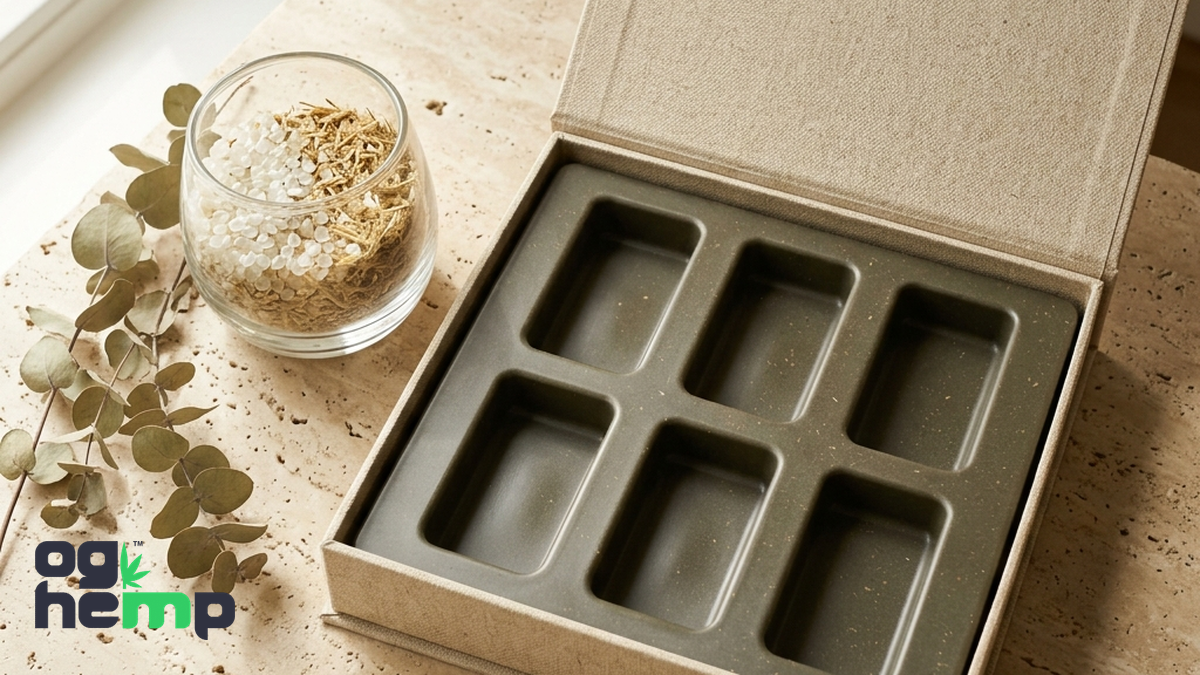
- Molded Monocarton Inserts: Hemp-PHA and Hemp-PBS blends replace petroleum plastic trays inside custom hemp paper boxes.
How do PHA and Bio-PBS biocomposites satisfy 2026 packaging regulations?
Both PHA and Bio-PBS biocomposites satisfy 2026 EU PPWR rules, Extended Producer Responsibility (EPR) laws, and international compostability standards including ISO 14855 and ASTM D6691.
By eliminating toxic microplastics and fluorinated chemicals (PFAS), both biopolymers ensure global exporters remain fully compliant with European Union and North American plastic reduction mandates while reducing carbon footprints.
Frequently Asked Questions About PHA vs. Bio-PBS & Hemp Composites?
What is the main difference between PHA and Bio-PBS bioplastics?
PHA is a microbial polyester made via bacterial fermentation offering high oxygen barriers and marine biodegradability, whereas Bio-PBS is synthesized chemically via polycondensation, providing high ductility, flexibility, and impact strength.
Can PHA and Bio-PBS be blended together?
Yes, blending PHA and Bio-PBS creates a synergistic polymer alloy that combines PHA’s barrier and marine breakdown properties with Bio-PBS’s flexible impact strength.
How does adding hemp fiber improve PHA and PBS packaging?
Compounding 30% to 50% hemp hurd reinforces structural stiffness, improves heat deflection temperature (HDT), and increases the renewable plant carbon content of the finished composite.
Do PHA and Bio-PBS leave toxic microplastics in soil or water?
No, both PHA and Bio-PBS biodegrade into natural organic biomass, water, and CO2 without generating synthetic microplastics.
Are Hemp-PHA and Hemp-PBS pellets suitable for existing molding machines?
Yes, both biocomposites operate as drop-in replacements in standard thermoplastic extrusion and injection molding equipment.