
How is the industrial hemp revolution transforming commercial packaging in 2026?
The industrial hemp revolution is transforming global packaging by providing a direct, scalable replacement for virgin wood paperboard and single-use plastic films, allowing multinational consumer goods brands to comply with strict 2026 European Union Packaging and Packaging Waste Regulations (PPWR) while reducing Scope 3 supply chain carbon emissions by up to 60%.
What carbon sequestration and ecological benefits make industrial hemp a climate-positive crop?
Industrial hemp absorbs up to 15 tonnes of CO2 per hectare during its rapid 90-to-120-day cultivation cycle, acting as a high-density carbon sink that replenishes agricultural soil quality through deep taproot phytoremediation without requiring synthetic pesticides, herbicides, or excessive irrigation.
Across global industrial supply chains, the transition toward circular, non-fossil materials has accelerated rapidly. For decades, commercial packaging and manufacturing relied on linear extraction models: clearcutting old-growth timber forests for paper pulp or synthesizing petroleum hydrocarbons for single-use plastic containers. Today, industrial hemp (Cannabis sativa L. with <0.3% THC) stands at the forefront of the bio-based material revolution, engineered by pioneering manufacturers like OG Hemp into high-caliper folding boxes, fine printables, and food-grade packaging suites.
Industrial Hemp vs. Wood Pulp & Petroleum Synthetics: 2026 Performance Matrix?
To understand why enterprise procurement teams are transitioning from conventional virgin substrates to agricultural hemp fibers, compare the fundamental physical, chemical, and environmental characteristics below:
| Property / Metric | Industrial Hemp Fiber | Commercial Timber Pulp | Petroleum Plastics / EPS |
|---|---|---|---|
| Cellulose Content | 70% – 85% (High Purity) | 30% – 45% (High Lignin) | 0% (Synthetic Hydrocarbons) |
| Agricultural Renewal | 90 – 120 Days (Annual Crop) | 15 – 25 Years (Deforestation) | Non-renewable (Fossil Extraction) |
| Recycling Endurance | 7 to 8 Lifecycles | 3 to 4 Lifecycles | 1 to 2 Cycles (Downcycling) |
| Carbon Sequestration | Up to 15 Tonnes CO₂/ha | Slow Long-term Accumulation | Net Carbon Emitter (>3.5 kg CO₂/kg) |
| Bleaching Chemistry | Non-toxic (H₂O₂ / Oxygen Delignification) | Chlorine / Dioxin byproducts | Toxic Plasticizers / PFAS risk |
| End-of-Life Degradation | 90 Days (Home Soil Compostable) | 6 – 12 Months | 400+ Years (Microplastic persistence) |
What commercial supply chain applications are driving industrial hemp adoption?
Commercial industrial hemp adoption is driven by 4 primary material sectors: custom folding monocartons for retail packaging, precision-milled commercial and artisanal paper sheets, barrier-lined compostable pouches, and high-strength biocomposites that eliminate synthetic plastics across global shipping operations.
1. Custom Folding Monocartons & Retail Packaging?
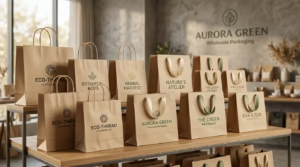
Modern luxury cosmetics, skincare jars, glass dropper bottles, and consumer goods require structural packaging that offers high rigidity without plastic lamination. OG Hemp manufactures custom folding mono cartons ranging from 250 to 450 GSM. Utilizing long bast fibers (15–25 mm), these cartons achieve high burst strength (TAPPI T 403) and crisp die-cut creasing that resists corner tearing on automated packing lines.
2. 100% Tree-Free Commercial & Fine Art Papers?
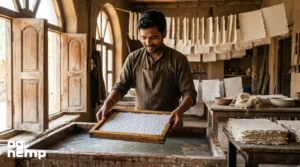
Unlike wood-based paper that degrades rapidly due to acidic lignin residues, industrial hemp contains under 10% natural lignin. This gives 100% tree-free paper natural archival permanence (ISO 9706), resisting yellowing and embrittlement for centuries. Offerings span from 100 GSM letterhead and books to handcrafted deckle edge handmade paper for luxury branding, certificates, and stationery.
3. Plantable Circular Botanical Goods?
Bridging packaging with post-consumer ecological renewal, zero-waste brands utilize plantable seed paper embedded with non-GMO wildflower and herb seeds. When placed under soil and watered, the organic pulp decomposes as a nutrient-rich mulch, germinating living plants and demonstrating true closed-loop circularity.
4. Compostable Barrier Films & Sachets?
Food and supplement packaging historically required aluminum foil or multi-layer polyethylene laminates that cannot be recycled. Industrial hemp cellulose films paired with bio-polymer heat-seal layers create fully compostable pouches that maintain essential oxygen and moisture barrier protection (WVTR) while meeting EN 13432 and ASTM D6400 soil compostability standards.
Why are global packaging regulations accelerating the industrial hemp transition?
Global packaging regulations are accelerating the industrial hemp transition by imposing punitive taxes on virgin plastics and non-recyclable multi-layer laminates while incentivizing certified bio-based agricultural materials across major export markets:
- European Union PPWR (Regulation EU 2025/40): Mandates that all packaging on EU markets must be recyclable or home-compostable by 2026/2030, penalizing petroleum laminates and non-circular materials.
- UK Plastic Packaging Tax (PPT): Imposes financial penalties on packaging containing less than 30% recycled or bio-based material, providing direct cost exemptions for 100% hemp fiber packaging.
- US FDA Food Contact Regulations (21 CFR 176.170 / 176.180): Ensures that unbleached, plant-based hemp paperboard is naturally free from synthetic PFAS coatings and heavy metal residues, making it ideal for food, pharmaceutical, and cosmetic containment.
Frequently Asked Questions About the Industrial Hemp Revolution?
The industrial hemp revolution is transforming global packaging by providing a direct, scalable replacement for virgin wood paperboard and single-use plastic films, allowing multinational consumer goods brands to comply with strict 2026 European Union Packaging and Packaging Waste Regulations (PPWR) while reducing Scope 3 supply chain carbon emissions by up to 60%.
Industrial hemp absorbs up to 15 tonnes of CO2 per hectare during its rapid 90-to-120-day cultivation cycle, acting as a high-density carbon sink that replenishes agricultural soil quality through deep taproot phytoremediation without requiring synthetic pesticides, herbicides, or excessive irrigation.
Industrial hemp paper is superior to wood pulp paper because it contains up to 85% pure cellulose (compared to ~35% in timber), enabling it to be recycled 7 to 8 times without structural degradation, while producing 4 times more usable fiber per acre on a 120-day renewal cycle.
Industrial hemp regenerates agricultural soils through deep taproot systems that break up soil compaction, prevent topsoil erosion, and bio-remediate heavy metals while returning vital organic micronutrients through natural leaf drop.
Yes, industrial hemp paper is fully compatible with commercial presses, including high-speed offset lithography, digital presses, flexographic printing, screen printing, embossing, and hot foil stamping using non-toxic soy-based and water-based inks.
OG Hemp provides flexible enterprise packaging MOQs starting at 500 units for custom printed folding monocartons, rigid retail boxes, and specialty paper grades, supporting emerging sustainable brands as well as multinational corporations.
Switching to hemp packaging significantly improves ESG ratings by eliminating Scope 3 deforestation impacts, reducing packaging lifecycle carbon footprints by up to 60%, and fulfilling Extended Producer Responsibility (EPR) mandates across international trade jurisdictions.
📚 Authoritative Scientific References & Industry Standards
- Technical Association of the Pulp and Paper Industry (TAPPI): Standard Test Methods for Tensile, Bursting Strength, and Fiber Length (Standards T 403, T 494).
- Centre for Natural Material Innovation, Cambridge University: Carbon Sequestration and Biocomposite Performance of Industrial Hemp (Dr. Darshil Shah, 15 tonnes CO₂/ha).
- European Parliament and Council: Regulation (EU) 2025/40 (PPWR) on Packaging and Packaging Waste and Circular Economy Standards.
- International Organization for Standardization: ISO 9706:1994 (Information and documentation — Paper for documents — Requirements for permanence).
- United Nations Environment Programme (UNEP): Global Deforestation Assessment and Alternative Fiber Supply Chains Report.
Engineer Your Custom Tree-Free Packaging Suite?
Join the industrial hemp revolution. Order certified tree-free folding boxes, archival fine paper sheets, or customized B2B packaging suites tailored to your brand’s sustainability targets.