Key Takeaways: Hemp Plastic Injection Moulding & Tooling
- Standard Tooling Compatibility: Hemp biocomposites compounded with BioPBS (Polybutylene Succinate) or modified PLA carrier matrices are engineered to run on standard reciprocating screw injection moulding machines without requiring dedicated tool steels or barrel re-engineering.
- Target Processing Envelope: Operating barrel temperatures are maintained between 150°C and 180°C to safeguard natural bast fibers from thermal pyrolysis, while maintaining linear mold shrinkage rates within 0.6% to 1.2%—directly comparable to polypropylene (PP) and high-density polyethylene (HDPE).
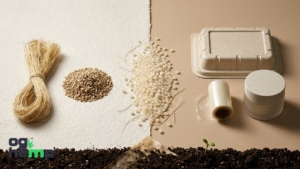
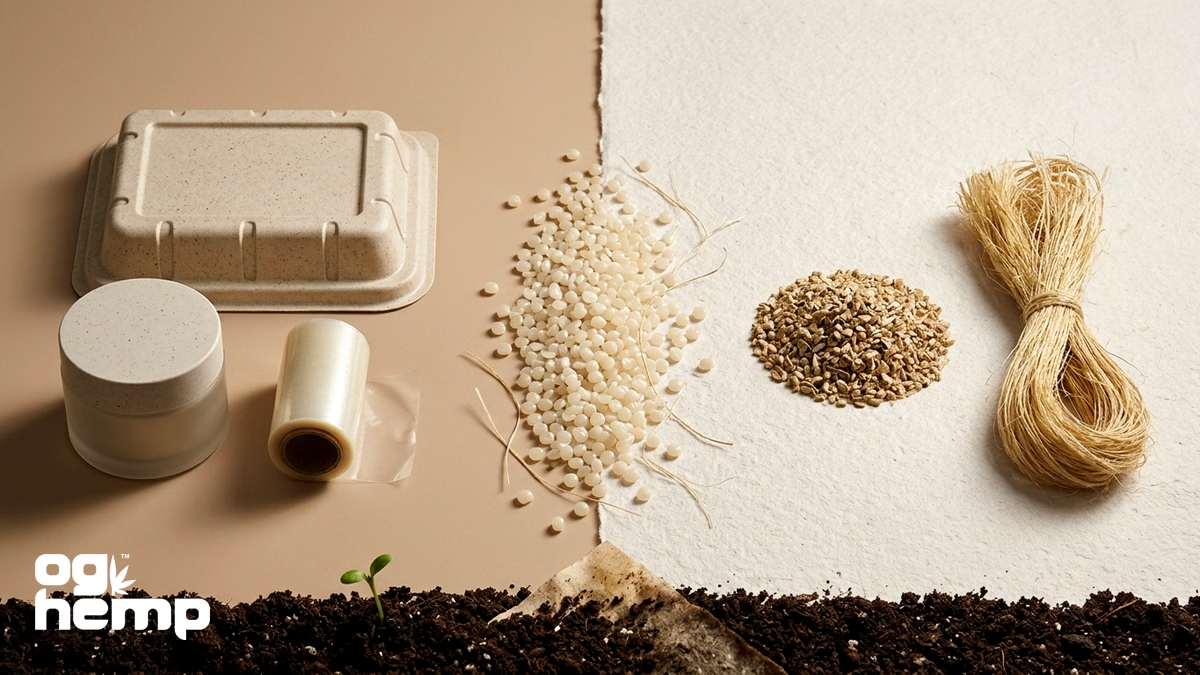
- Micro-Fiber Reinforcement: Compounding 15% to 30% cottonized hemp bast micro-fibers elevates flexural modulus and structural rigidity, preventing isotropic shrinkage and edge warpage in precision cosmetics jars, caps, and rigid thin-wall packaging.
- Indian Regulatory Compliance: Finished biocomposite parts compounded with certified biodegradable polyesters achieve compliance with India’s Plastic Waste Management (PWM) Rules and Central Pollution Control Board (CPCB) standards under IS/ISO 17088 protocols.
Can standard injection moulding machines process hemp plastic without retooling?
Standard reciprocating screw injection moulding machines process hemp biocomposite pellets without expensive tool replacements or specialized machinery, provided barrel heating zones and screw geometries are adjusted to respect the processing windows of plant fiber composites. Industrial convertors operating conventional toggle or hydraulic presses can transition from commodity petrochemical resins like polypropylene (PP) or polystyrene (PS) to hemp-reinforced Polybutylene Succinate (BioPBS) simply by purging the barrel and optimizing temperature setpoints. Because natural cellulose fibers undergo thermal discoloration and degradation above 200°C, the composite matrix is formulated with low-melting-point bio-polyesters, allowing full plasticization, cavity filling, and pack-and-hold cycles to complete smoothly at melt temperatures between 155°C and 180°C.
For packaging convertors and moldmakers across India and international manufacturing hubs, this drop-in capability eliminates the multi-crore capital expenditures traditionally associated with transitioning to sustainable packaging. Rather than building dedicated clean-sheet tooling, packaging engineers can utilize existing P20, H13, or aluminum prototype mold bases. Runner systems, including cold runners and balanced hot runner manifolds with appropriately sized gate orifices, accommodate the fiber-loaded melt without freezing or fiber bridging.
What are the processing parameters and mold shrinkage rates for hemp biocomposites?
Target processing parameters for hemp plastic injection moulding require barrel melt temperatures between 155°C and 175°C, mold tool temperatures between 25°C and 45°C, and linear shrinkage rates ranging from 0.6% to 1.2% based on published BioPBS engineering envelopes. These shrinkage values align closely with the shrinkage envelopes of commercial polyolefins (PP exhibits 1.0%–2.0% shrinkage, while HDPE exhibits 1.5%–3.0%), enabling toolmakers to achieve precise dimensional repeatability on parts designed for snap-fit lids, threaded cosmetic closures, and tight-tolerance electronic enclosures.
Maintaining tight process control requires packaging technicians to manage four interdependent processing variables:
- Moisture Pre-Drying: Natural hemp fibers are inherently hydrophilic. Prior to feeding into the machine hopper, biocomposite pellets must be desiccated in a dehumidifying dryer at 65°C to 75°C for 3 to 4 hours until moisture content drops below 0.05% (500 ppm). Processing damp resin triggers hydrolytic polymer chain scission in the polyester matrix, causing splay marks, loss of tensile strength, and unpredictable part weight.
- Back Pressure & Screw Speed: Back pressure must be minimized (typically 0.3 to 0.8 MPa) and screw recovery speeds kept moderate (40 to 80 RPM). Excessive rotational shear generates frictional heat that can locally scorch cellulose micro-fibers, generating dark specks and volatile odors.
- Injection Speed & Gate Dynamics: Medium-to-slow injection speeds prevent shear-induced degradation at narrow gate restrictions. Submarine, pin, and edge gates should feature generous land lengths and minimum diameters of 1.5 mm to allow intact fiber flow without clogging.
- Holding Pressure & Cooling Cycles: Because BioPBS is a semi-crystalline aliphatic polyester, holding pressure (40 to 70 MPa) must be held until gate freeze-off occurs. Cooling times typically range from 12 to 28 seconds depending on nominal wall thickness (1.2 mm to 3.5 mm).
How do hemp biocomposites compare to polypropylene and neat biopolymers?
Hemp biocomposites compounded with BioPBS outperform neat PLA and conventional polypropylene by delivering elevated flexural modulus, reduced mold sink marks, and authentic ambient soil biodegradability without yielding long-lasting synthetic microplastics. While neat (unfilled) PLA suffers from high brittleness and deforms under modest ambient heat (glass transition temperature around 55°C), the incorporation of refined hemp bast fibers creates internal mechanical reinforcement that stabilizes part geometry across elevated ambient temperatures.
Commodity Polypropylene (PP)
- Feedstock: 100% Fossil Fuel Petroleum
- Melt Window: 200°C–240°C
- Shrinkage: 1.2%–2.0% (Higher sink risk)
- Flexural Modulus: ~1.2–1.5 GPa
- End of Life: Persistent non-biodegradable polymer; generates microplastics in natural soil
- Regulatory Status: Subject to intensifying single-use packaging bans & EPR levies
Neat Polylactic Acid (PLA)
- Feedstock: Corn starch / sugarcane
- Melt Window: 180°C–210°C
- Shrinkage: 0.3%–0.5% (Brittle fractures)
- Flexural Modulus: ~3.5 GPa (High stiffness, low impact)
- End of Life: Requires commercial industrial composting facilities at >58°C; persists in open soil
- Regulatory Status: Often restricted where municipal industrial composters are unavailable
Hemp-Reinforced BioPBS Composite
- Feedstock: Bio-succinic acid & cottonized hemp bast
- Melt Window: 155°C–175°C (Energy efficient)
- Shrinkage: 0.6%–1.2% (Controlled dimensional stability)
- Flexural Modulus: >2.8–4.2 GPa (Target engineering envelope)
- End of Life: Verified ambient soil and home compostable biodegradation
- Regulatory Status: Exempt from SUP bans under CPCB & IS/ISO 17088 standards
How do cottonized bast micro-fibers prevent warpage in thin-wall packaging?
Cottonized bast micro-fibers eliminate differential shrinkage and part warpage by forming a randomized internal skeletal lattice that uniformly distributes thermal contraction stresses as the molten biopolymer solidifies. In standard injection moulded packaging—such as wide-mouth cosmetic cream jars, compact powder cases, and aerosol overcaps—asymmetrical wall thicknesses and uneven tool cooling frequently cause perimeter curling and ovality in screw threads. Bast fibers, characterized by an intrinsic elastic modulus exceeding 40 GPa and high length-to-diameter aspect ratios ($p ge 20$), resist compressive thermal contraction along the flow direction.
In addition to structural stability, the presence of refined bast micro-fibers imparts an appealing aesthetic quality to consumer packaging. Rather than the artificial sheen of petroleum plastics, hemp biocomposite surfaces exhibit a warm, organic matte texture with faint micro-fiber highlights. This tactile presentation visually reinforces a brand’s authentic commitment to circularity without requiring synthetic surface texturing or secondary soft-touch coatings.
Who are the leading hemp plastic manufacturers and compounders in India?
OG Hemp Pvt. Ltd. leads the engineering and compounding of advanced hemp paperboard and biocomposite materials in India, collaborating with converters, toolmakers, and sustainable brands to deliver customized raw material masterbatches and turnkey packaging components. Headquartered in India and supporting international supply chains across North America, Europe, and the Middle East, OG Hemp provides technical compounding expertise tailored to specific conversion requirements, including melt flow index (MFI) adjustments, natural color masterbatching, and fiber mesh sizing.
While the Indian market has historically faced fragmented supply chains for natural fiber polymers, domestic infrastructure is accelerating rapidly. By establishing rigorous processing guidelines for local injection moulding facilities in industrial belts such as Pune, Gujarat, and the National Capital Region (NCR), OG Hemp enables commercial brands to source certified domestic biocomposites while avoiding costly international ocean freight and currency fluctuations.
What is the prototyping and custom tooling workflow for hemp plastic parts?
The custom prototyping workflow for hemp plastic parts moves through four structured engineering stages: 3D CAD optimization, Moldflow rheology simulation, rapid prototype aluminum tooling, and hardened multi-cavity steel production. Partnering with experienced biocomposite tooling engineers ensures that part draft angles, radii, and gating locations are correctly configured before steel is cut.
- CAD & Rheological Simulation: Component CAD files are evaluated for wall thickness uniformity (ideally 1.5 mm to 2.8 mm). Finite element mold filling simulations evaluate fill time, fiber orientation vectors, clamp tonnage requirements, and weld line positioning to ensure structural integrity across high-stress zones.
- Prototype Aluminum Tooling: For design verification and physical drop testing, single-cavity prototype tools cut from aircraft-grade 7075 aluminum deliver 500 to 5,000 functional sample parts within 2 to 3 weeks at a fraction of production tool pricing.
- Compounding & Trial Optimization: Pilot runs evaluate resin flowability and cycle times. Fiber loading ratios (15%, 20%, or 25%) are fine-tuned to balance impact toughness against rigidity.
- Hardened Production Tooling: Final multi-cavity tools machined from H13 or S7 hardened tool steel with wear-resistant surface treatments ensure reliable million-cycle lifetimes under continuous production schedules.
What packaging applications are best suited for injection moulded hemp plastics?
Injection moulded hemp biocomposites are optimized for high-value rigid and semi-rigid packaging formats, including cosmetic jars and closures, personal care compacts, consumer electronics housings, and food service utensils. By combining high tensile strength with natural moisture barrier attributes, these biocomposites provide a drop-in replacement for single-use containers where flexible paper alone cannot deliver structural enclosure:
- Cosmetic & Skincare Packaging: Heavy-wall 30 ml and 50 ml skincare cream jars, treatment pump collars, luxury perfume bottle caps, and lipstick barrels that maintain dimensional stability and prevent oil permeation. Brands can pair these rigid containers with our hemp biocomposite films and wraps for fully circular packaging suites.
- Food & Beverage Service Ware: Reusable and single-use injection moulded cutlery, coffee pod capsules, dry food scoops, and rigid beverage closures that comply with food-contact migration standards.
- Nutraceutical & Wellness Containers: Moisture-resistant bottles and tamper-evident screw lids engineered to protect organic herbal formulations, vitamins, and supplements from ambient humidity.
- Consumer Tech & Luxury Goods: Molded protective earphone cases, luxury watch storage cores, and sustainable stationery accessories that replace fossil-fuel ABS and polycarbonate resins.
Are injection moulded hemp plastics compliant with India’s CPCB and PWM regulations?
Injection moulded hemp plastics compounded with certified compostable polyesters comply with the Central Pollution Control Board (CPCB) and Plastic Waste Management (PWM) Rules in India when tested and certified under Indian Standard IS/ISO 17088 for compostable plastics. Under India’s statutory PWM framework, conventional single-use plastics under strict micron limits are prohibited, while certified compostable materials carry explicit manufacturing and commercial circulation clearances.
Convertors and brand owners utilizing certified hemp biopolymers benefit from three regulatory and economic advantages:
- Exemption from Single-Use Prohibitions: Rigid biocomposite parts that disintegrate in managed compost environments without leaving ecotoxic heavy metals or persistent microplastics meet the compliance mandate established by India’s Ministry of Environment, Forest and Climate Change (MoEFCC).
- CIPET Laboratory Certification: Testing protocols conducted through the Central Institute of Petrochemicals Engineering & Technology (CIPET) validate biodegradation percentages, disintegrability, and plant toxicity baselines required for CPCB registration certificates.
- Extended Producer Responsibility (EPR) Offsets: Utilizing bio-based, compostable packaging assists brand owners in meeting annual EPR recovery targets, shielding businesses from non-compliance fines and plastic credit surcharges.
Engineer Your Custom Hemp Bioplastic Packaging
Accelerate your brand’s transition to circular packaging with OG Hemp’s technical engineering team. We supply compounded biocomposite masterbatches, prototype tooling support, and full-scale contract manufacturing.
What are common questions about hemp plastic injection moulding?
Can hemp biocomposites be colored with standard masterbatches?
Yes, hemp biocomposites accept bio-based and food-contact approved color masterbatches, though the natural golden-tan hue of hemp fibers creates an earthy, warm undertone. Earth tones, terracotta, forest greens, charcoal, and warm stone shades yield consistent color saturation without masking the natural micro-fiber texture.
What is the minimum wall thickness achievable with hemp plastic?
Minimum recommended wall thicknesses for hemp injection moulding range between 1.2 mm and 1.5 mm to ensure uniform fiber dispersion and prevent short shots. Thin-wall sections below 1.0 mm require higher injection pressures and optimized gate placement to prevent fiber stagnation.
Do hemp fibers cause abrasive tool wear on injection molds?
Cottonized hemp bast fibers are significantly less abrasive than synthetic glass fibers or mineral fillers like talc and calcium carbonate, causing minimal wear on standard P20 and H13 mold steels. Standard polished tool surfaces maintain their surface finish over hundreds of thousands of production cycles.
Can regrind and runner scrap be recycled back into the machine?
Clean production sprues and runners can be granulated and blended back into virgin pellets at ratios between 5% and 15% without compromising tensile properties, provided regrind material is thoroughly dried to prevent thermal degradation during re-melting.