What are the best sustainable packaging options for brands in India?
The best sustainable packaging options in India include 100% tree-free hemp paper folding cartons, compostable plant-based pouches, and molded fiber inserts that comply with CPCB single-use plastic ban mandates and Extended Producer Responsibility (EPR) recycling targets.
📋 Indian CPCB & EPR Packaging Regulatory Compliance
Under India’s 2026 Plastic Waste Management Rules, brands switching from plastic laminates to certified tree-free hemp packaging achieve 100% exemption from EPR plastic recycling fees and municipal landfill penalties.
The Global Push for Responsible Packaging: What’s Driving the Change?
The sustainable packaging market has reached a reported $325 billion globally, growing at over 7% annually. This isn’t a niche trend — it’s a fundamental restructuring of how products are packaged, shipped, and delivered worldwide.
Three converging forces are driving this shift. Regulation is tightening — the EU’s Packaging and Packaging Waste Regulation (PPWR) and extended producer responsibility (EPR) laws in dozens of countries are making sustainable packaging a compliance requirement rather than a choice. Consumer demand is rising — a 2024 McKinsey survey found that a majority of consumers expect brands to use environmentally responsible packaging. And corporate ESG commitments are forcing procurement teams to re-evaluate every material entering their supply chain.
For businesses evaluating their sustainable packaging options, the challenge isn’t finding eco-friendly alternatives — it’s choosing among the many available. Each material category offers distinct advantages and tradeoffs that depend on product type, budget, infrastructure, and brand values.
Why the World Is Switching to Sustainable Packaging?
Regulatory Pressure?
The EU PPWR, adopted in 2025, sets ambitious targets: all packaging must be recyclable or reusable by 2030, with mandatory recycled content quotas and restrictions on certain single-use formats. Similar legislation is emerging across Asia, North America, and Australia. For brands selling internationally, compliance with the strictest regulation effectively sets the standard for all markets.
India’s Plastic Waste Management Rules and bans on single-use plastics in multiple states have accelerated the domestic shift. Extended producer responsibility laws now require brands to fund collection and recycling infrastructure — creating a direct financial incentive to use materials with better end-of-life outcomes.
Consumer Demand?
Approximately 78% of consumers expect brands to use sustainable packaging (McKinsey, 2024). This isn’t just stated preference — purchase behavior reflects it. Brands that have switched to visible sustainable packaging report improvements in customer perception, repeat purchase rates, and willingness to pay premium prices.
The effect is strongest in categories like food & beverage, cosmetics, and e-commerce — where packaging is a tangible expression of brand values. A brown box with recycled-content messaging can be more effective for brand positioning than a glossy alternative.
Corporate ESG Commitments?
Hundreds of the world’s largest companies have committed to net-zero targets, plastic waste reduction goals, and 100% recyclable or compostable packaging timelines. These commitments cascade through supply chains — if a Fortune 500 company pledges to eliminate virgin plastic by 2030, every supplier and vendor must adapt.
Procurement managers now evaluate packaging vendors on sustainability metrics alongside cost and performance. This structural demand shift is creating stable, long-term markets for sustainable packaging solutions.
Natural Fiber Packaging: Hemp, Bamboo, Agave & Beyond?
Natural fiber packaging is where the most interesting innovations are happening — and also where the most misconceptions exist. Many brands assume “natural” means “less durable” or “more expensive across the board.” The reality depends heavily on which fiber you’re using and how it’s processed. Most prototype runs we do are under 500 units before customers commit to production tooling — and typical MOQs for natural fiber packaging start around 1,000 pieces for standard designs, scaling up based on customization complexity.
Natural fiber packaging uses plant-based materials that are renewable, biodegradable, and increasingly versatile. This category includes some of the oldest and most innovative packaging materials available.
Hemp — The Regenerative Powerhouse?
Hemp grows to maturity in 12 months — compared to 20-80 years for trees — making it one of the most rapidly renewable resources available, according to the European Industrial Hemp Association. What surprises many brands is that hemp isn’t just a sustainability choice; the natural texture communicates premium quality without requiring heavy inks or coatings. Clients have chosen hemp packaging specifically because it eliminated the need for laminated finishes — simplifying recyclability while improving shelf appeal. One drawback people rarely consider upfront: hemp paper absorbs ambient humidity differently than coated paper. Warehousing conditions matter more than many first-time buyers expect. We always advise brands to test storage behavior before committing to large production runs.
Hemp fibers produce paper, boards, and packaging materials that are strong, lightweight, and fully biodegradable. The material is naturally mold-resistant and provides excellent protection for packaged goods.
One practical consideration: hemp paper’s natural variations in texture and color mean brands need to embrace slight inconsistencies in their packaging. For products where absolute uniformity matters, processed hemp blends offer more consistency while retaining the sustainability benefits.
Bamboo — Rapid Renewable?
Bamboo grows even faster than hemp, reaching maturity in 3-5 years. It’s used for rigid packaging applications — boxes, containers, and structural inserts — where its strength-to-weight ratio is valuable. Bamboo packaging is biodegradable and visually distinctive, often used in premium product positioning.
Flax — A Traditional Fiber with Modern Applications?
Flax is one of the oldest cultivated plants, with fibers traditionally used for textiles and paper. In packaging, flax fibers add strength and durability to paper boards, composite materials, and molded packaging. Flax grows well in temperate climates, requires minimal irrigation, and produces long, strong fibers ideal for reinforcing bio-composite materials. It’s increasingly used in rigid packaging where extra tear resistance is needed.
Pros and Cons?
Advantages: Rapidly renewable (12-month growth cycles), home-compostable, biodegradable, carbon-sequestering during growth, naturally mold-resistant, excellent tactile and aesthetic qualities.
Tradeoffs: 10-25% cost premium vs conventional alternatives, supply chain less established than tree-based paper, limited color and finish options compared to synthetic materials, variable availability by region. The supply chain concern is diminishing — more paper mills now run dedicated hemp processing lines than even two years ago.
Best Use Cases?
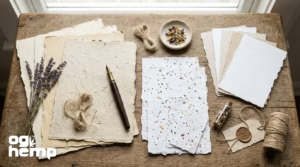
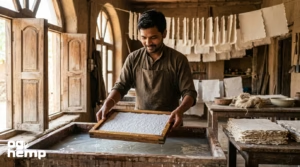
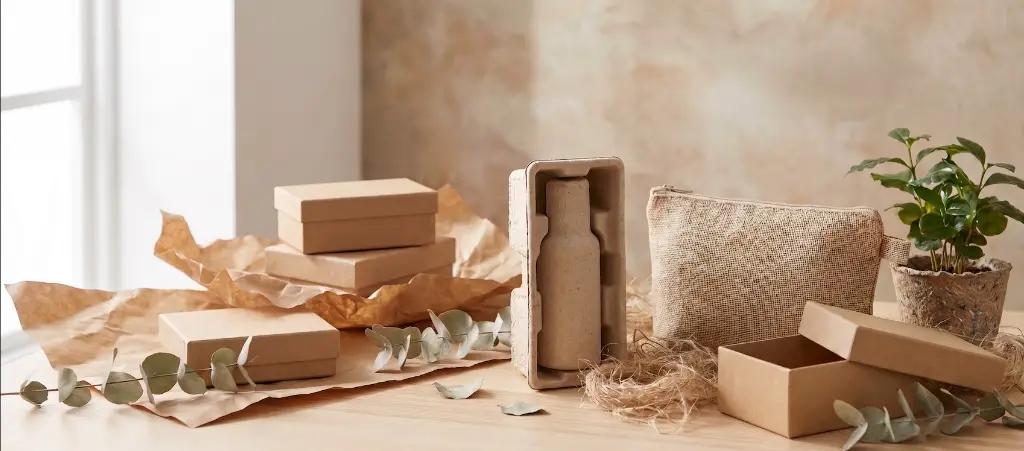
Natural fibers excel in boxes and rigid packaging, paper wraps and pouches, luxury brand packaging where the natural aesthetic adds value, stationery and paper products, and protective void fill. At OG Hemp, we manufacture natural fiber packaging across these categories — boxes, pouches, and deckled edge paper — from hemp and other natural fibers.
Plant-Based Bioplastics: PLA, PBS, PHA & Starch-Based Alternatives?
Here’s where the sustainable packaging conversation gets complicated. Bioplastics are derived from renewable sources — corn, sugarcane, cassava — rather than petroleum. They solve one problem (fossil fuel dependency) while introducing another (disposal infrastructure). A common mistake: brands choosing compostable films without checking whether their customers actually have access to industrial composting.
PLA (Polylactic Acid)?
PLA is made from fermented plant starch — typically corn, cassava, or sugarcane. It’s the most widely used bioplastic, suitable for clear films, rigid containers, and compostable bags. PLA is industrially compostable in facilities that maintain specific temperature and humidity conditions.
Important caveat: PLA requires industrial composting infrastructure to break down properly. In landfills or home compost bins, it persists similarly to conventional plastics. In India, industrial composting infrastructure is concentrated in major metro areas — Delhi-NCR, Mumbai, Bangalore, Chennai — with limited coverage in Tier 2 and Tier 3 cities. Brands using PLA need to map their end-of-life reality, not just their sustainability intentions.
PHA (Polyhydroxyalkanoate)?
PHA is produced by microorganisms that ferment sugars or oils. Unlike PLA, PHA is marine-degradable and home-compostable — it breaks down in natural environments including soil and water. This makes PHA attractive for applications where packaging may escape closed-loop disposal systems.
PHA remains more expensive than PLA and conventional plastics, but production capacity is scaling rapidly. It’s currently used in specialty applications where biodegradation in natural environments is critical.
PBS (Polybutylene Succinate)?
PBS is one of the few biopolymers we recommend when heat resistance matters. If you’re packaging warm food or products that may sit in hot delivery vehicles — common in Indian summers — PBS usually outperforms PLA. It offers better thermal resistance and flexibility, making it suitable for hot food containers and durable films. PBS is compostable under industrial conditions and its mechanical properties are closer to conventional polypropylene than most other bioplastics, which makes it an attractive drop-in alternative for existing manufacturing lines.
Starch-Based Blends?
Starch-based materials — often derived from corn, potato, or tapioca — are blended with other biopolymers to create flexible films and loose-fill packaging. These are among the most cost-effective bioplastic options, with established supply chains and competitive pricing.
Pros and Cons?
Advantages: Renewable feedstocks (not petroleum), compostable options available, transparent films possible (good for visibility), food-safe, established supply chains for PLA.
Tradeoffs: Most require industrial composting (not home compostable), PLA can contaminate plastic recycling streams if not sorted, agricultural land use concerns, performance limitations in high-heat applications, 15-30% cost premium.
Best Use Cases?
Compostable pouches and stand-up pouches for dry goods, flexible films for food packaging, sachets for single-use portions, compostable bags and liners, and food service packaging and containers.
Pulp Moulded Packaging: Molded Fiber as a Plastic Replacement?
Our engineering team noticed a pattern over the years: brands optimizing for a single sustainability metric — say, biodegradability — while ignoring whether the material actually protects their product through the supply chain. Pulp moulded packaging often wins precisely because it balances sustainability with practical performance.
Pulp moulded packaging — also called molded fiber — is made from recycled plant based pulp pressed into custom shapes. It’s one of the oldest sustainable packaging technologies, but recent innovations have dramatically expanded its applications.
How Pulp Moulding Works?
Recycled paper and cardboard are broken down into a slurry, mixed with water, and pressed into molds under heat and pressure. The result is a rigid, lightweight, and highly customizable packaging form. Different molding techniques produce different surface finishes — from the rough texture of egg cartons to the smooth finish of premium retail packaging.
The Manufacturing Advantage?
Unlike many packaging processes that require separate suppliers for tooling, material formulation, and production, pulp moulding can be vertically integrated. Manufacturers with in-house end-to-end capabilities — including tooling design, mold fabrication, material mixing, and production — can iterate faster and deliver more consistent quality. Skilled engineers develop custom tooling and material formulations tailored to each product’s specific requirements, adjusting fiber composition, density, and surface finish to achieve the desired performance and appearance. This integrated approach reduces lead times, improves quality control, and enables rapid prototyping for brands testing new packaging designs. The same vertically integrated model applies to mono carton packaging, where in-house tooling and material expertise drive consistent results.
Applications?
Traditional pulp moulding covers egg cartons, fruit trays, and cup carriers. Advanced molded fiber now produces retail packaging inserts, electronics packaging, cosmetic compacts, and even some rigid boxes that rival plastic in appearance and performance. Brands in cosmetics, electronics, and luxury goods use molded fiber for its sustainability story and design flexibility.
Pros and Cons?
Advantages: Made from recycled content (highly circular), fully recyclable and home-compostable, cost-effective (5-15% premium vs plastic), excellent shock absorption for protective packaging, well-established recycling infrastructure.
Tradeoffs: Limited durability for heavy or sharp items, not moisture-resistant without coatings (which may affect recyclability), less design flexibility than plastic injection molding, surface finish limitations for premium applications.
Best Use Cases?
Protective packaging and shipping inserts, retail and point-of-purchase displays, cosmetic and personal care packaging trays, food service containers, and electronics packaging.
Bio-Composites: The Next Frontier in Sustainable Packaging?
Bio-composites combine natural fibers with bio-based polymers to create materials with enhanced strength, durability, and functionality — bridging the gap between natural materials and engineered synthetics. In practice, we’ve found this category generates the most excitement in R&D conversations but often requires the longest lead times for production-scale orders.
What Are Bio-Composites?
A bio-composite is a matrix material (typically a bio-based polymer or resin) reinforced with natural fibers (hemp, flax, jute, or agricultural waste). The result combines the renewability of natural fibers with the structural performance of engineered materials. These materials can be molded, extruded, or formed into rigid packaging shapes.
Hemp-Based Bio-Composites?
Hemp fibers are particularly effective in bio-composites due to their length, strength, and thermal properties. Hemp-based bio-composites are used for rigid packaging, structural inserts, and reusable packaging systems. They offer durability comparable to petroleum-based plastics with a significantly lower environmental footprint.
Agricultural Waste Composites?
Agricultural byproducts — wheat straw, rice husks, sugarcane bagasse, oat hulls — are being transformed into composite packaging materials. These materials use waste streams that would otherwise be burned or landfilled, creating circular value from existing agricultural systems.
Pros and Cons?
Advantages: Highly durable (competitive with conventional plastics), customizable properties, uses agricultural waste streams, biodegradable options available, strong aesthetic for premium brands.
Tradeoffs: Emerging technology with limited large-scale production, 20-40% cost premium over conventional alternatives, fewer suppliers and longer lead times, end-of-life infrastructure still developing for some composite types.
Best Use Cases?
Rigid and semi-rigid packaging requiring durability, reusable packaging systems, structural inserts and protective components, premium and luxury brand packaging, and industrial and bulk packaging applications.
Sustainable Packaging Options Compared: Which Material Is Right for You?
No single sustainable packaging option is universally superior. The right choice depends on product characteristics, supply chain infrastructure, budget, and brand positioning. This comparison table summarizes the key differences:
| Factor | Natural Fibers | Bioplastics | Pulp Moulded | Bio-Composites |
|---|---|---|---|---|
| Renewable Source | High (hemp, bamboo regrow rapidly) | Medium (corn, sugarcane) | Medium (recycled paper) | High (natural fibers) |
| Biodegradability | Home-compostable | Industrial compostable (most) | Home-compostable | Variable |
| Durability | Medium-High | Medium | Low-Medium | High |
| Cost vs Conventional | 10-25% premium | 15-30% premium | 5-15% premium | 20-40% premium |
| Best For | Boxes, pouches, wraps | Films, pouches, sachets | Trays, inserts, protectors | Rigid packaging, structural |
| Market Maturity | Mature | Growing | Mature | Emerging |
Key Takeaways from the Comparison?
Natural fibers offer the best balance of renewability, biodegradability, and established production — ideal for brands prioritizing rapid renewable sourcing. Bioplastics fill the critical need for transparent, flexible packaging where natural fibers can’t compete. Pulp moulded is the most cost-effective and circular option for protective and insert packaging. Bio-composites are the frontier for applications demanding high durability with sustainable materials.
The most effective strategy for many brands is a hybrid approach — using different sustainable packaging options for different components based on functional requirements.
Quick Decision Guide: If Your Priority Is?
| Priority | Consider This Material |
|---|---|
| Lowest cost sustainable option | Pulp moulded |
| Premium retail appearance | Hemp fiber |
| Transparency / product visibility | PLA bioplastic |
| Heat or moisture resistance | PBS bioplastic or bio-composites |
| Shipping and shock protection | Pulp moulded |
| Luxury brand positioning | Natural fiber (hemp/bamboo) |
| Full home compostability | Natural fibers or pulp moulded |
| Drop-in plastic replacement | PBS or starch-based bioplastic |
How to Choose the Right Sustainable Packaging for Your Product?
Define Your Product Requirements
Map the non-negotiables first: weight, fragility, moisture barrier, shelf life. The most sustainable option is the one that protects the product through your actual supply chain.
Map Your Disposal Infrastructure
Match the material to where customers actually dispose. A compostable pouch that ends up in a landfill isn’t a sustainable choice — it just costs more.
Match Your Brand & Budget
Cost premiums range from 5% to 40%. Some materials signal sustainability more visibly than others. Pick what aligns with your margins and brand story.
Step 1: Assess Your Product’s Physical Requirements?
One trend that’s become clear over the last few years: brands that start with physical requirements — not sustainability goals — end up with packaging that performs AND is more sustainable than their current option. Start with your product’s needs: Is it heavy or fragile? Does it require a moisture barrier? What’s the shelf life? A 500g jar of skincare cream has different packaging requirements than a lightweight e-commerce accessory. Map your non-negotiable performance criteria first — then find the most sustainable material that meets them.
Step 2: Evaluate Your Supply Chain and Disposal Infrastructure?
A packaging material is only as sustainable as the infrastructure available to process it at end of life. If your products are sold in markets without industrial composting facilities, PLA bioplastics may not realize their compostability benefit. If your customers have curbside paper recycling, pulp moulded and paper-based natural fiber packaging integrate seamlessly.
Step 3: Align with Your Brand Values and Budget?
Sustainable packaging typically carries a cost premium of 5-40% depending on the material and complexity. For premium brands, this premium may be absorbed as a brand investment. For margin-sensitive categories, pulp moulded or natural fiber options at the lower end of the premium range may be more appropriate.
The sustainability story also matters for marketing — natural fibers offer a visible, tactile sustainability signal that customers recognize. Bioplastics may require more customer education about proper disposal.
Real-World Example: Scale Changes Everything?
We work with clients ranging from Marriott Hotels to emerging D2C brands, and the difference in priorities tells you everything about how to approach sustainable packaging.
For a large-scale operator like Marriott, the decision is organization-wide — driven by global ESG commitments, centralized procurement, and the ability to absorb a cost premium across thousands of SKUs. Their focus is on reliability at volume, consistent quality across markets, and certifications that satisfy international compliance requirements.
Smaller brands face a different equation entirely. For a boutique cosmetics label or a regional food brand, the primary concerns are minimum order quantities, per-unit cost impact on margins, and whether the sustainable option communicates the right brand message on shelf. A 15% premium that’s negligible for a multinational can be the difference between profit and loss for a 50-SKU brand.
The takeaway: don’t benchmark your packaging decisions against what a Fortune 500 company does. The right sustainable option depends on your scale, your customer base, and your specific cost structure.
Step 4: Test Before You Commit?
Order samples from multiple suppliers. Run small production batches. Test in your actual fulfillment and retail environment. A material that performs well in the lab may behave differently in summer heat, humid warehouses, or rough shipping conditions. Most reputable packaging manufacturers offer product samples and prototype runs to help you evaluate before committing at scale.
Emerging Sustainable Packaging Options to Watch?
Mycelium-Based Packaging?
Mycelium — the root structure of mushrooms — can be grown into custom shapes around a mold, creating lightweight, fire-resistant, fully compostable packaging. Companies like Ecovative have commercialized mycelium packaging for protective shipping and retail displays. Production scale is still limited, but the material’s unique properties make it promising for specialty applications.
Algae-Based Bioplastics?
Algae can be farmed in saltwater or wastewater, producing biomass that can be processed into bioplastics without competing with food crops. Algae-based materials are marine-degradable and can be produced with a net-negative carbon footprint. Several startups are scaling production, with commercial packaging applications expected within 2-3 years.
Edible Packaging?
Edible films and coatings made from seaweed, starches, and proteins are emerging for single-use applications like seasoning packets, beverage pods, and food wraps. While niche today, edible packaging eliminates waste entirely for specific use cases and has attracted significant investment.
Advanced Bio-Composites?
Research continues into stronger, cheaper, and more versatile bio-composites — combining agricultural waste with bio-based resins to create materials that can compete on cost and performance with petroleum-based plastics for a wider range of applications.
Frequently Asked Questions About Sustainable Packaging Options?
What is the most sustainable packaging material?
There is no single “most sustainable” material — sustainability depends on application, supply chain, and end-of-life infrastructure. Generally, materials that use rapidly renewable resources (hemp, bamboo) and can be processed in existing recycling or composting systems score highest. Natural fibers and pulp moulded packaging perform well across multiple sustainability dimensions. The best sustainable packaging option for your business will depend on your specific product requirements and disposal infrastructure.
Is sustainable packaging more expensive?
Generally yes, though the premium varies significantly. Pulp moulded packaging carries the smallest premium (5-15%), while advanced bio-composites can be 20-40% more expensive than conventional alternatives. As production scales and supply chains mature, these premiums are expected to narrow. Many brands offset the cost through improved brand perception, customer retention, and regulatory compliance. For context on how premium materials deliver value, see our guide to premium gift boxes and sustainable packaging.
Can sustainable packaging replace plastic completely?
For most applications, yes — but not with a single material. A combination of natural fibers, bioplastics, pulp moulded, and bio-composites can cover nearly all packaging needs. The challenge is not material availability but infrastructure — recycling and composting systems must evolve to handle diverse material types. Some specialized applications (medical, long-term storage, extreme conditions) will likely continue using conventional materials for the foreseeable future.
How do I know if a packaging material is genuinely sustainable?
Look for third-party certifications: FSC for responsibly sourced fibers, OK Compost HOME or TUV Austria for home compostability, BPI or DIN CERTCO for industrial compostability. Be wary of vague claims like “eco-friendly” or “green” without specific certifications or data. A credible supplier should provide lifecycle data, sourcing information, and end-of-life guidance.
What are the easiest sustainable switches my business can make?
Start with high-volume, low-complexity packaging: replace plastic void fill with paper or molded fiber, switch poly bags to compostable pouches, transition rigid boxes to natural fiber or recycled content materials. These changes typically require minimal operational adjustment while delivering measurable sustainability improvements and visible brand benefits.
The Shift Is Happening — Where Will Your Brand Stand?
The global shift to responsible packaging is not a future trend — it’s happening now. With a $325 billion market growing at over 7% annually (Mordor Intelligence, 2026), the choice is no longer whether to adopt sustainable packaging but which materials to use and how to implement the transition effectively.
Each material category — natural fibers, bioplastics, pulp moulded, and bio-composites — offers distinct advantages and honest tradeoffs. The brands that succeed will be those that match their sustainable packaging options to their specific product needs, supply chain realities, and customer expectations.
We manufacture natural fiber packaging at OG Hemp for hospitality groups, consumer brands, and various independent businesses across multiple industries. We know the right packaging decision is different at every scale. If you’re exploring a switch, we recommend ordering samples and running your own tests in your actual environment — not someone else’s.
Request a sample kit to test natural fiber packaging for your specific application. Or browse our collection to see what we currently produce.